On any given day aboard a nuclear-powered fast-attack submarine, a single broken valve, mismatched ventilation duct, or delayed engineering drawing can stall a multi-million-dollar maintenance project in its tracks. In the high-stakes environment of a dry dock, where time is the most unyielding constraint, finding a workaround is not just a matter of convenience—it is a mandate of national security.
At Norfolk Naval Shipyard (NNSY), the central nerve center answering that mandate for the shipyard’s first Virginia-class Extended Drydocking Selected Restricted Availability (EDSRA) is the USS John Warner (SSN 785) Engineering and Planning (Code 200) Trouble Desk.
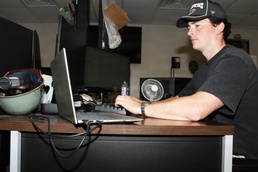
Under the jurisdiction of the Chief Engineer (Code 240), the trouble desk represents an elite, highly diverse task force assembled from various Code 200 divisions. From structural and electrical experts to mechanical and propulsion engineers, this multidisciplinary team lives on the deckplate ready to assist the project. While these types of teams are sometimes referred to as a “trouble desk,” those serving the John Warner project prefer to go by a different name.
"Collectively, as a trouble desk, we like to call it the 'solution desk,'" said Project Engineer and Planning Manager Joshua Clements. "Production comes to us with their problems, we vet them, and we resolve them right there."
The arrival of John Warner marked a historic first for the public shipyards. Commissioned in 2015, John Warner is the first Block III Virginia-class submarine to undergo an EDSRA at any of the nation’s four public shipyards.
The vast majority of the “solution desk” crew had spent the previous decade working the complex conversions of the Los Angeles-class attack submarines MTS San Francisco (MTS 711) and MTS La Jolla (MTS 701) into moored training ships for use at Nuclear Power Training Unit-Charleston. Those massive, historic conversion projects required separating the hulls to recycle the center sections, and hoisting in entirely new, 700-ton, fully equipped modules before joining the vessels back together again.
"Most of us came off of those conversion projects," Clements said. "Transitioning from those massive structural overhauls back to a modern fast-attack submarine was a unique challenge. It was a completely different beast, and it really forced us to think outside the box to keep problem resolution times as low as possible."
Because the Virginia class is a highly complex, automated platform, many of its mechanical systems heavily rely on integrated electrical controls. This required an unprecedented level of interdisciplinary collaboration for the trouble desk, breaking down the traditional silos where engineers of different codes rarely interacted.
Mechanical Engineer Ryan Satira noted that this collaborative environment extends directly to the shipyard's production workforce.
"I really enjoy interfacing with the mechanics on the boat, getting away from the desk, and being hands-on," Satira said. "It is 100 percent a two-way street. Especially for younger engineers, finding a good mechanic and learning their trade knowledge is incredibly beneficial. It helps us write much better work documents because we understand the physical reality of what they face on the deckplate."
This "solution desk" philosophy drove the team to improve the previous deficiency form process, allowing engineers to verify and approve technical fixes directly on the submarine in real-time, sometimes saving days in the process.
"We took a process that normally took three to five days and brought it down to the same day—often within a single shift," Clements explained. "If a mechanic has a problem on the deckplate and we can resolve it on the spot with a pen and ink, they go right back to work immediately. It minimized the administrative churn and kept the job moving."
This rapid response on the deckplate dramatically minimized work stoppages and served as a significant catalyst for John Warner achieving a timely undocking in March 2026.
The trouble desk's relentless drive was put to the ultimate test during the submarine's recent "Hot Ops" testing phase—the complex, high-pressure evolution of lighting up and steaming the vessel's propulsion plant. To support the round-the-clock testing schedule, members of the trouble desk worked grueling 12-hour shifts for nearly three weeks straight, with some engineers working 20 consecutive days without a break to ensure success.
The marathon effort paid off. The tests were executed flawlessly, finishing weeks ahead of historical averages. Members say a lot of the credit for the team’s success goes to the family-like atmosphere.
"Oh man, we’re like a family down here," said Job Planning Leader Jeffrey Raiford. "We work together better than any team I've ever been a part of. When the timeline got tight and we were approaching our undocking milestones, everyone just buckled down, worked together, and got first-time quality paper out the door. Seeing what we've been able to accomplish on a first-of-its-kind availability for this yard is something we will look back on with incredible pride."
As John Warner prepares for sea trials and return to the active fleet, the engineers of the Code 200 Trouble Desk are already looking toward the future, documenting their triumphs to use toward future availabilities. By combining bold, out-of-the-box administrative courage with a tightly knit, family-first culture, this Norfolk Naval Shipyard team didn't just repair a submarine—they forged a faster, safer, and more efficient pathway to global readiness, proving that the ultimate solution to the Navy's toughest problems can be found right on the deckplates of America's Shipyard.