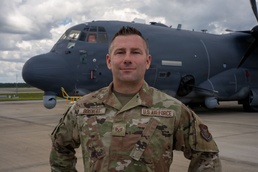
HURLBURT FIELD, Fla. – “I just reacted and my instincts took over.”
When Staff Sgt. Justin Boisvert came upon a serious vehicle crash, the maintainer did not hesitate—he ran to the smoking truck, helped free the injured driver and provided aid until first responders could take over.
What was to be an ordinary drive to work at Hurlburt Field June 17. 2026, placed the Air Force Reservist at the center of a life or death episode following an automobile accident that could have turned tragic for a local community member.
Around 1:15 p.m., Boisvert was heading south on State Road 87, listening to a podcast as he often does. Just ahead of him, Ronnie Bowie was leaving his home to beat an incoming storm after repairing his roof. Suddenly, traveling near 60 mph, Bowie suffered a cardiac-related medical emergency and lost consciousness.
His truck veered hard to the right, jumped the curb, and went airborne for a moment before striking a tree and proceeded to roll partially into a ditch.
“I did not stop to process it at all,” Boisvert said.
Boisvert immediately pulled his vehicle over and ran down into the ditch toward the crushed, smoldering truck. Inside the cabin, which was filled with dust and smoke from deployed airbags and leaking fluids, Bowie was severely injured, disoriented, and bleeding from his head.
“I was more worried about his safety than anything,” Boisvert said.
Amid the chaos, Boisvert worked to free the injured driver from the vehicle. After releasing the jammed seat belt, he moved the driver to safety and used a nearby towel to apply pressure to the head injury.
Though disoriented, Bowie was able to provide Boisvert with his wife’s phone number to give to first responders. When Boisvert spotted a fire department vehicle traveling in the opposite direction, he waved it down. First responders soon arrived and transported the driver for emergency care.
In the days that followed, the driver reflected on how narrowly the timing had worked in his favor.
"If I had stayed in my yard another eight minutes, no matter what would have happened, nobody would have been there for two or three more hours," Bowie recalled. "I was blessed that Justin was behind me to help me. He didn’t hesitate to get in there and get me out of that truck."
For Boisvert, his instinctive response was supported by his background. His experience as a lifeguard, combined with military training in first aid and cardiopulmonary resuscitation (CPR), helped him provide immediate aid until emergency personnel arrived.
“I think the training definitely helped, knowing the steps to go through, how to call for aid and how to inspect someone for further injuries,” Boisvert said. “All the training I have completed throughout my military career helped me remain calm in moments of chaos.”
Boisvert's concern for Bowie didn't end once first responders transported him to a nearby hospital. He stayed at the scene providing information to authorities and personally called Bowie's wife to explain the situation. In the days following the crash, Boisvert remained in contact with Bowie and his family.
“All he was concerned about was, ‘Are you going to be okay? Is there anything I can do for you?’” Bowie said. “He just wanted to make sure I was all right. That’s just the kind of person he is.”
The two men remain friends today and despite the immense gratitude from Bowie's family and the formal recognition he is set to receive for his heroism, Boisvert remains characteristically modest.
“I didn’t pull over that day to receive praise,” he said. “I was just in the right place at the right time, and I’m thankful I could be there for him.”
But on that day in June when a stranger needed help, Boisvert acted without hesitation and provided immediate, lifesaving aid.
When asked what he hopes others will take away from the incident, his answer was simple.
“Just help others,” Boisvert said. “If you see someone broken down on the side of the road or someone who needs help, just do whatever you can do to help them out.”