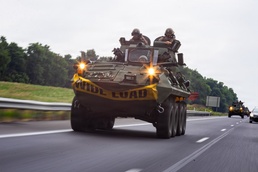
NEW ORLEANS-- Marine Forces Reserve conducted Reserve Mobilization Exercise 26 this summer, testing the rapid mobilization and combat readiness of units across its major subordinate commands nationwide.
The annual exercise serves as a critical benchmark to gauge how quickly and efficiently MARFORRES can activate and deploy ready forces if called upon. This year's iteration saw active participation from units within the 4th Marine Division, 4th Marine Logistics Group, 4th Marine Aircraft Wing and Force Headquarters Group. Designed to simulate a large-scale, short-notice activation, RMX 26 required thousands of Reserve Marines to transition from their civilian careers, assemble at their home training centers, inspect their equipment, and rapidly deploy to training sites across the country.
"The Reserve Mobilization Exercise is in place to gauge the readiness of the Reserve in a specific unit, to see any effect of mobilization, see what shortfalls we may have, or where efficiencies are and find where we could tighten up our plans," said U.S. Marine Corps Gunnery Sgt. Jared McCarty, company gunnery sergeant for Company C, 4th Law Enforcement Battalion, Force Headquarters Group.
McCarty emphasized that while smaller-scale mobilization drills occur regularly, the expanded scope of RMX 26 reflects a direct response to current global operational requirements.
"The Marine Corps is a force in readiness, and the Reserve is a force in readiness to that force," McCarty said. "It's a reminder of what we're really here for. To be ready at a moment's notice."
A premier showcase of this collective readiness spanned across the United States, demonstrating the mobilization capability of the ground combat, aviation, logistics and command elements.
In the East, Marines with 4th Light Armored Reconnaissance Battalion, 4th Marine Division, executed strategic embarkation procedures at sites across Maryland and Pennsylvania. Personnel staged, inspected and loaded Light Armored Vehicles onto transport platforms, preparing the combat assets for rapid coast-to coast movement to Camp Pendleton, California.
On the West Coast, Marines and Sailors with 4th Medical Battalion, 4th Marine Logistics Group, validated rapid-readiness processing pipelines and conducted cargo-loading operations at Camp Pendleton to guarantee immediate medical operational capability. Simultaneously, Marine Wing Support Squadron 473, 4th Marine Aircraft Wing, stood up operational infrastructure at Marine Corps Air Station Miramar, California, executing rigorous cargo validation and tactical equipment repositioning to sustain distributed aviation logistics.
In the Midwest, Company C, 4th Law Enforcement Battalion, Force Headquarters Group, integrated with Airmen from the U.S. Air Force's 87th and 89th Aerial Port Squadrons at Wright-Patterson Air Force Base, Ohio. Marines and Airmen conducted joint cargo inspections and staged vital assets inside strategic transport aircraft, verifying all gear complied with strict weight, balance, and hazardous material protocols before flight.
"We're checking to make sure that all of our personnel are accounted for and that the gear is serviceable," said U.S. Marine Corps Sgt. Keaton Dennis, a squad leader with Company C, 4th Law Enforcement Battalion. "Making sure that basically we have beans, bullets, and band-aids -- everything that we're going to need for this deployment, and we're ready to be operable as soon as we hit the ground."
Leaders across Marine Forces Reserve will utilize the logistical and operational data collected throughout RMX 26 to refine future mobilization procedures, ensuring that the Reserve force remains an agile, lethal, and seamless extension of the active-duty component.