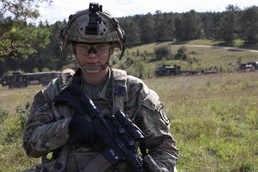
HOHENFELS, Germany — An observer coach/trainer with Adler Team, Joint Multinational Readiness Center, 7th Army Training Command, and his daughter, a logistics officer with Headquarters Distribution Company, Light Support Battalion, 173rd Mobile Brigade Combat Team (Airborne), are both serving in the U.S. Army but filling very different roles during exercise Saber Junction 26, Aug. 15-Sept. 13, at the Joint Multinational Readiness Center’s Hohenfels Training Area, Germany.
A father and daughter serving in the U.S. Army at the same time may not be unusual, but the odds of both participating in Saber Junction 26, an annual combat training center exercise focused on validating the readiness and lethality of U.S. Army Europe and Africa forces, are slim.
“I joined the Army in 1994 because my grandfather was in the Army. Watching him through my years as a child, I always had respect for what he had done, so I decided that’s what I wanted to do,” said U.S. Army Command Sgt. Maj. Kerry Schnitz.
“It’s an honor to have served seven years in the U.S. Army Reserve and 25 years on active duty,” said Kerry Schnitz.
“He is getting closer to retirement every day, but not quite as close as you would think,” said U.S. Army 2nd Lt. Karissa Schnitz.
“He’s probably held every position possible on the enlisted side, from being a basic training drill sergeant, first sergeant, command sergeant major and now an OC,” said Karissa Schnitz.
“Top four in my career is being selected to be a drill sergeant, my time as a first sergeant, being selected to go to the Sergeants Major Academy and being out here in the box for my last rotation with my daughter,” said Kerry Schnitz. “I’m a senior sustainment noncommissioned officer who observes, coaches and trains brigade support battalions or light support battalions during a rotation,” said Kerry Schnitz.
He said his role on this rotation of Saber Junction 26 is to observe, coach and train the Light Support Battalion, 173rd Mobile Brigade Combat Team (Airborne).
“Being assigned to JMRC as an OC/T has really enabled me to see sustainment as a big enterprise and how the Army is changing, becoming a lighter and more lethal force,” said Kerry Schnitz.
“Right now with my position, my rank, what I bring is the workload of the TAC,” said Karissa Schnitz.
“During this exercise I am the TAC - 1 battle captain who is receiving and sending forward all the battle tracking information and receiving and sending forward everything for sustainment to the CLCs,” said Karissa Schnitz.
Combat logistics companies provide forward sustainment to maneuver units, while the brigade support area serves as the brigade’s larger logistics hub. In other words, her tactical command post element sits between the forward combat logistics companies and the larger brigade support area, helping connect the forward fight to the brigade’s main sustainment hub.
“To me, to participate in the same exercise is huge personally because, as I’ve said before, one of the main things I’ve learned from him is giving it all you’ve got, and I think he gives this exercise everything that he has,” said Karissa Schnitz.
“Observing, coaching and training. We provide feedback to the rotational training unit, 173rd Airborne Brigade, for sustainment on what they’re doing right and what they could do a little bit different,” said Kerry Schnitz.
“And we provide that feedback to them so at the end of the day they can leave here a more trained and lethal organization,” said Kerry Schnitz.
“I don’t think it’s any different knowing that he’s an evaluator,” said Karissa Schnitz.
“Like I said, he gives it all to any job that he has and he’s not losing that posture at all just because I’m out here,” said Karissa Schnitz.
“I think it’s pretty cool and I’m not sure a lot of people realize, but this is his very last rotation so he’ll be PCS’ing next month,” said Karissa Schnitz.
“Just being able to have this opportunity and being able to see the training that she’s going through and seeing that it all pays off and knowing that she’s going to be a better officer for coming through the training,” said Kerry Schnitz.
Kerry Schnitz said he looks forward to seeing her take what she learned during the exercise and apply it throughout her military career.
“I’ve been here for two years, and being able to end my time as an OC/T with the Adler Team and having my daughter be a part of the rotational training unit in the LSB, which the Adler Team is OC’ing, has just been probably the biggest highlight of my career,” said Kerry Schnitz.
“Seeing her serve just puts me at ease knowing that I will be able to retire knowing that we have the best of the best out here training and are ready for anything our nation calls us for,” said Kerry Schnitz.
“Her very first rotation and my last,” said Kerry Schnitz.
“My little experience, this being my first rotation, the best I can do is do what I know to do to the best capability and learn and soak in as much information as I possibly can,” said Karissa Schnitz.
“I mean, just experience and time in real-world scenarios, he has me beat by a million miles on that one,” said Karissa Schnitz.
“If I could give her one piece of advice for her military career it would be to never compromise her integrity, keep pushing and always accept challenges that are involved with what we do,” said Kerry Schnitz.
“To be on a training and have my daughter here on my last rotation, her first rotation really, just solidifies the fact that her training and everything she’s learned is culminating in this event,” said Kerry Schnitz.
“To me, and I think to both of us, it’s kind of a passing off of the torch moment,” said Karissa Schnitz.
“I couldn’t be prouder to be wearing this uniform and standing next to him,” said Karissa Schnitz.
“I’m super proud of him and he is my real-life hero,” said Karissa Schnitz.
“The Army has been great to myself and my family, and it’s great to see my daughter carry on this tradition,” said Kerry Schnitz.
“It’s great to see her out here training and she’ll be able to take it from here,” said Kerry Schnitz.