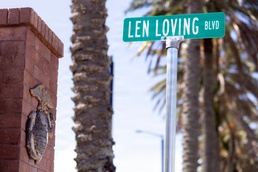
Blount Island Command marked its 40th anniversary Sept. 4 by renaming Channel View Boulevard, the main road at Marine Corps Support Facility Blount Island, for Col. Francis “Len” Loving, its inaugural commanding officer.
Members of Loving’s family and four former commanding officers joined service members, civilians and contractors from across the military installation to rededicate the command colors and unveil the Len Loving Boulevard sign.
The observance came 40 years after Biennial Maintenance Command was established Sept. 1, 1986. Redesignated Blount Island Command on May 11, 1989, the organization has supported Marine Corps operations from Desert Storm to the present and now generates, sustains, modernizes and distributes ready-for-issue, service-managed equipment for rapid employment worldwide.
The day began with a motivational run through maintenance areas and along the Marine Corps facility’s 1,000-foot slipway. Later that morning, personnel gathered inside Clamshell 4, an expeditionary structure, for the ceremony.
U.S. Marine Corps Col. David Merles, commanding officer of Blount Island Command, described the command’s history as an inheritance passed from one generation of the workforce to the next. Facing Loving’s family, former commanding officers and today’s workforce, he spoke beside the Len Loving Boulevard sign, concealed beneath a black cloth and framed by state flags and camouflage netting.
“Unlike a title, which is earned, an inheritance is given,” Merles said. “It is passed down to us by those who have gone before us.”
Merles said each generation can grow that inheritance through its intellect, talent and effort, tracing it back to Loving and the original team he led.
Commissioned in 1960, Loving served multiple tours in Vietnam during a nearly 30-year Marine Corps career and received the Bronze Star Medal with combat “V.” He also commanded 3rd Recruit Battalion at Marine Corps Recruit Depot Parris Island, South Carolina, and served as executive officer of Marine Barracks Washington.
The Marine Corps began leasing 262 acres on Blount Island July 1, 1986, for maritime prepositioning. Two months later, Loving took command of the newly established Biennial Maintenance Command and helped turn the concept into an operational capability.
Loving brought his wife, Suzie, to Blount Island about a month after they married.
“I thought, ‘He’s got to be out of his mind,’” she said. “There was nothing here except sand, lots of sand, this one little road and that big blue building. Now it’s a real base.”
The model allowed Marines to deploy and integrate with equipment already positioned in theater rather than move every vehicle, weapon system and supply item from the United States.
The approach proved its value during Operation Desert Shield and Operation Desert Storm, when the 7th Marine Expeditionary Brigade used equipment already positioned in theater to establish defensive positions rapidly in Saudi Arabia, reducing demand on strategic lift.
Blount Island Command’s official lineage later recorded participation in Operation Iraqi Freedom, Operation Enduring Freedom and Operation Inherent Resolve, along with crisis response and humanitarian assistance missions in the Philippines, Somalia, Haiti and elsewhere.
The rededicated command colors carry streamers recognizing national defense, expeditionary service and campaigns in Southwest Asia, Afghanistan and Iraq.
As prepositioning expanded, the Marine Corps acquired more than 1,100 acres on Blount Island in 2004 and established Marine Corps Support Facility Blount Island Nov. 21, 2006. The installation provides the infrastructure, workforce and maritime access that support Blount Island Command’s mission.
Today, the Marine Corps’ global positioning network links afloat and ashore prepositioning programs with sustainment nodes and distribution pathways. The command keeps service-managed equipment properly configured, accountable and ready for issue, helping position combat capability closer to potential operating areas while reducing reliance on strategic lift.
Merles credited successive generations of the workforce with surging production for maritime prepositioning ships, expanding prepositioning in Norway, deploying personnel during combat operations and helping establish shore-based nodes in the Pacific.
“Our Corps has put its prepositioning mission on the backs of Blount Island’s workforce,” Merles said. “Blount Island — always forward, always ready — has always punched above its weight class.”
Loving continued serving veterans after retiring from the Marine Corps, spending nearly 15 years leading Jacksonville’s Five Star Veterans Center and helping veterans facing homelessness, post-traumatic stress disorder, traumatic brain injuries and addiction.
He died June 9 at age 87.
“He was a great Marine but a better person,” Suzie Loving said. “He cared about everybody that he came across.”
Merles renamed the road from the military installation’s main gate to Blount Island Command headquarters Len Loving Boulevard during the Sept. 4 ceremony.
Suzie Loving said her husband was modest and never sought recognition, but she believed the road would keep his name connected to the command he helped establish.
“They’ll say, ‘I’m going to take Len Loving Boulevard’ or ‘You take Len Loving Boulevard,’” she said. “Everyone will remember Loving because it’s such an unusual name.”
She encouraged today’s workforce to consider how work that appears modest now can grow into something much larger.
“Remember, when he first came here, it was nothing,” she said. “Something that might seem small now, that you’re working on today, could be huge later on for Blount Island, for the Marines, for America.”