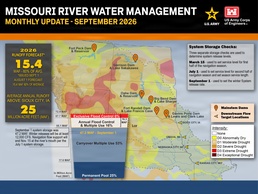
OMAHA, NE – August runoff in the Missouri River Basin above Sioux City, Iowa was 1.0 million acre-feet (MAF), 73% of average. Runoff was well below normal in the Fort Peck and Garrison reaches due to dry soil moisture conditions and areas of below-normal precipitation. Runoff was above normal for the Oahe, Fort Randall, and Gavins Point reaches, and near normal in the Sioux City reach, mostly due to above-normal precipitation during parts of August.
“August runoff was higher than forecast in the lower reaches of the upper Missouri River Basin above Sioux City due to late summer rainfall. In addition, rainfall below Gavins Point allowed the System reservoirs to maintain lower release rates while meeting the reduced navigation flow targets at all downstream locations,” said John Remus, chief of the U.S. Army Corps of Engineers’ Missouri River Basin Water Management Division. “Runoff in the Fort Peck and Fort Peck to Garrison reaches continue to be well-below average due to long-term precipitation deficits and dry soil conditions in the upper Basin. The levels of the three upper reservoirs, Fort Peck, Garrison, and Oahe dropped about 1 to 2 feet in August, and System storage will continue to decline this fall,” Remus added.
The U.S. Drought Monitor indicates that over 83% of the Missouri River Basin is abnormally dry or in drought conditions. Drought conditions are expected to improve in Colorado, southern Wyoming, and western Nebraska and Kansas by the end of November as El Nino conditions strengthen.
September runoff in the upper Basin is forecast to be well-below average, especially in the Fort Peck and Garrison reaches. The updated 2026 calendar year forecast for the upper Basin is 15.4 MAF, 60% of average. Average annual runoff for the upper Basin is 25.7 MAF.
As of Sept. 1, the total volume of water stored in the System was 47.2 MAF, down 1.3 MAF during August. The updated reservoir studies indicate that the System storage is expected to be 43.8 MAF, approximately 12.3 MAF below the base of flood control, at the start of the 2027 runoff season.
The Fort Peck release will be maintained at 7,000 cfs during the fall months and into early winter. The Garrison release will be reduced from 17,000 cfs to 13,000 cfs starting on Sept. 14.
Navigation Gavins Point Dam will provide navigation flow support at the minimum-service level through the end of the navigation season at all four target locations (Sioux City, Omaha, Nebraska City, and Kansas City). The flow support season length will be shortened, ending November 15 at the mouth of the Missouri River. Flow targets may be missed to conserve water if there is no commercial navigation in a given reach.
Fall Release Rate Gavins Point releases can be reduced to water supply release rates during extended droughts when the navigation flow support season ends earlier than December 1 per the Master Manual. Gavins Point releases may be reduced to the water supply release of 9,000 cfs for approximately two weeks prior to the winter release rate beginning on December 1. Downstream tributary flows will be monitored during this period, and releases will be adjusted as necessary if there is not sufficient flow downstream of Gavins Point.
Winter Release Rate As per the criteria in the Master Manual, the winter release rate is determined based on the Sept. 1 System storage. Per Sept. 1 System storage, winter releases from Gavins Point Dam will be at least 12,000 cfs. In anticipation of the low winter releases, a letter will be sent in September to water users below Gavins Point Dam making them aware of the planned fall and winter releases and encouraging them to assess the risk to their facilities.
Monthly Water Management Conference Calls for 2026: The September 2026 monthly conference call will be held Thursday, Sept. 10, to inform basin stakeholders of current weather and runoff forecasts and the planned operation of the reservoir system in the coming months. This will be the final scheduled call for 2026. Presentation materials will be available via webinar. The call is intended for Congressional delegations; Tribes; state, county and local government officials; and the media. It will be recorded in its entirety and made available to the public on our website at https://go.mil/mr-news. Slides accompanying the call will be available at:https://go.mil/mr-monthly-slides.
Fall Public Meetings The Northwestern Division will host a series of public meetings during the last week of October. The dates and locations of the meetings are still being finalized.
Reservoir Forecasts:
Gavins Point Dam
Fort Randall Dam
Big Bend Dam
Oahe Dam
Garrison Dam
Fort Peck Dam
The forecast reservoir releases and elevations discussed above are not definitive. Additional precipitation, lack of precipitation or other circumstances could cause adjustments to the reservoir release rates.
Hydropower: The six mainstem power plants generated 762 million kWh of electricity in August. Typical energy generation for August is 1,000 million kWh. The power plants are projected to generate 7.1 billion kWh of electricity this year, compared to the long-term average of 9.3 billion kWh. To view the detailed three-week release forecast for the mainstem dams, go to https://go.mil/mr-3wk-fcast.