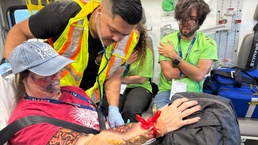
Evans Army Community Hospital personnel participated in a full-scale Mass Casualty exercise simulating a commercial aircraft crash at the Colorado Springs Airport Aug. 19, 2026.
Teams from the City of Colorado Springs, Colorado Springs Airport, fire department, law enforcement, emergency management, community hospitals, Peterson Air Force Base and more than two dozen additional partners participated in a realistic emergency response scenario. The exercise was conducted in accordance with Federal Aviation Administration regulations, which require airports to complete full scale emergency drills every three years to ensure operational preparedness.
Operating alongside key military and civilian emergency agencies, EACH Emergency Medical Services conducted patient triage and transport, helped conduct advanced medical moulage for 60+ casualty actors, and verified secure communication channels with regional emergency management operations.
“Participation in exercises like this with our community partners is vital to validate joint medical readiness and solidify the operational link between military and civilian partners,” said Rodney G. Herring, EACH Emergency Manager.“These exercises promote interoperability, which directly translates to optimized life-saving capabilities during high-consequence, real-world crises.”
Amanda Rantis, a Public Communications Specialist for the Colorado Springs Airport, says that community partners like EACH play a critical role in preparing the city and airport for mass casualty events by providing essential medical expertise and resources.
“Their participation ensures that emergency response plans account for coordinated patient care, triage, and treatment beyond the immediate crisis scene,” Rantis said. “Bringing together healthcare providers with agencies like fire, police, emergency management, and military units creates a comprehensive, integrated approach to managing such complex situations. This collaboration strengthens communication channels, builds trust, and improves overall efficiency, ultimately helping the entire community to respond more effectively and save lives during real emergencies.”
Herring says that participation in the exercise establishes the baseline for subsequent training.
“This exercise helped us successfully achieve our training objectives, “Herring said. “Forfuture iterations, we will integrate a wider scope of departments to maximize training effectiveness and inter-agency participation.”