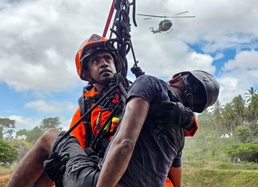
KATUNAYAKE, Sri Lanka — Montana National Guard Soldiers and Airmen joined Sri Lankan military personnel and civilian professionals during Atlas Angel II, a five-day subject matter expert exchange centered on disaster response and strengthening the partnership between Montana and Sri Lanka.
The exchange brought together specialists from the Montana National Guard, Pacific Air Forces, other U.S. military organizations, Montana civilian agencies and the Sri Lankan Armed Forces. Events took place in Katunayake and Kandy from Aug. 31 through Sept. 4.
Subject matter experts from both countries compared techniques, shared lessons learned and worked through real-world disaster response challenges together.
“The overall objective is relationship building,” said Master Sgt. Nicholas Schwall, assistant training chief with the Montana Air National Guard Fire Department. “Through relationship, we just share knowledge. We learn from them, they learn from us.”
The exchanges covered landslide response, urban search and rescue, medical response, C-130 aircraft maintenance, incident command systems, construction engineering and chemical, biological, radiological, nuclear and explosive emergency response.
Schwall took part in urban search and rescue exchanges that included high-angle and horizontal rescue, confined-space operations, concrete breaching and structural shoring. Participants also worked through scenarios requiring teams to locate victims and safely operate around damaged structures.
Schwall said many of the techniques used by Sri Lankan responders were similar to those used by firefighters and rescue teams in Montana.
“It’s been really fun to learn how they do things and how very similar” the approaches are, Schwall said.
Urban search and rescue also complemented landslide response scenarios conducted earlier in the week. Once debris is cleared and responders identify a void or damaged structure, rescue teams may need to enter unstable areas to locate victims.
“Safety is paramount and we can’t have another victim,” Schwall said while describing the importance of shoring damaged structures before rescuers enter.
Civilian expertise also played a role in the landslide response exchange.
Martin “Mort” Larson, a geotechnical engineering specialist with the Montana Department of Transportation, traveled to Sri Lanka to share an engineering perspective and work alongside Sri Lankan specialists.
“It’s not a one-stop shop,” Larson said. “It involves multiple entities and multiple people.”
Sri Lankan specialists demonstrated how they assess landslide impact zones, identify needed resources and use technology to evaluate hazards before responders enter affected areas.
Larson said the exchange also gave him a close look at Sri Lanka’s landslide science program.
“I met with their scientist and their landslide program that they’ve got going on is top-notch,” Larson said. “They are basically mirror imaging what we’re doing over in the States.”
Sri Lankan specialists shared information about landslide databases, susceptibility modeling and mitigation efforts. The two sides also discussed the use of drones and LiDAR technology.
Larson said those conversations showed the value of the two-way exchange.
“We’re able to take the knowledge that I know and give it to these guys and say, ‘Hey, where can we improve,’ but also learn from them as well,” Larson said.
Medical personnel also compared approaches to prehospital care and austere medicine.
Sgt. Justin Adair, a combat medic specialist assigned to Headquarters and Headquarters Company, 1st Battalion, 189th General Support Aviation Battalion, participated as a subject matter expert during the medical exchange.
Sri Lankan personnel worked through scenarios involving triage, patient extrication and the establishment of casualty collection and treatment areas. U.S. personnel observed portions of the exercise and exchanged feedback with their counterparts.
“The information exchange has been really helpful,” Adair said.
Adair said working directly with Sri Lankan physicians gave him an opportunity he does not routinely experience in Montana.
“Working directly in an information exchange with physicians is unique for me because generally in my experience I’m working with other 68 Whiskeys, maybe flight paramedics, but not higher-level providers generally,” Adair said. The professional exchange also created opportunities to build personal relationships.
“The cultural exchange as well as the information exchange with the counterparts has been amazing,” Adair said. “This is my first experience and I hope to come back.”
Larson described a similar experience during his first State Partnership Program engagement in Sri Lanka. “I’m stepping away, walking away from this as having not just partnerships, but actually building a friendship,” Larson said.
Montana and Sri Lanka have worked together through the State Partnership Program for five years. The relationship has grown from military exchanges to include civilian agencies and other professional organizations.
That cooperation led to the first Atlas Angel exercise in 2024, when Montana National Guard C-130 aircraft traveled to Sri Lanka and participated in disaster response activities with members of the Sri Lanka Air Force, Army and Navy.
Atlas Angel II expanded that relationship by bringing together a broader group of specialists and placing greater emphasis on shared expertise.
Montana participants brought experience responding to wildfires, floods, severe weather and other emergencies at home. Sri Lankan participants shared experience responding to flooding, landslides and other natural disasters.
Atlas Angel II concluded Sept. 4, but the lessons and relationships developed during the exchange will continue through future State Partnership Program engagements.