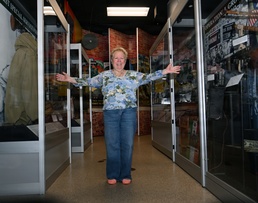
FORT BRAGG, N.C. - For the community passing through the Special Operations Center of Excellence at the U.S. Army John F. Kennedy Special Warfare Center and School at Fort Bragg, North Carolina, history is more than a collection of dates, names, and artifacts.
It is a way to understand its legacy.
The JFK Special Warfare Museum, the regimental museum for Special Forces, Civil Affairs and Psychological Operations, preserves the history of the Army's special operations forces while serving as a three-dimensional classroom for the Soldiers who will carry that legacy forward.
Roxanne Merritt, the museum director, said its mission is to represent the history of the regiments, past and present, while supporting the training of special operations students assigned to the schoolhouse.
“The Soldier comes in here and learns where their current training fits into the legacy,” Merritt said.
The museum was first established in 1963 by Brig. Gen. William P. Yarborough, the then commander of the U.S. Army Special Warfare Center and School. By preserving that history, the museum offers more than a look into the past. It provides a way for visitors and future generations of Soldiers to understand the experiences, traditions, and lessons that have shaped special operations.
For Merritt, that connection is similar to genealogy.
“A Soldier learning where they fit in the legacy can see how the work being done today connects to the work of previous generations,” Merritt said. “They can recognize that many of the tasks they are learning have roots in the past, while understanding that the work they do today will eventually become part of the history studied by those who follow them. We're all kind of in this together.”
That student-to-legacy connection is important within special warfare, where Special Forces, Civil Affairs and Psychological Operations unite as a collective force in history. Each contributes to the larger mission. The museum uses that shared history as part of the training process.
Students entering the Special Warfare Center and School receive orientation at the museum. Language students use exhibits and topics as material for translating into the languages they are studying.
Warrant officers use exhibits to examine historical events through the lens of planning and courses of action and other considerations, rather than simply viewing them as historical sequences.
The museum's connection to the program of instruction makes it more than a repository for artifacts. It becomes part of the education and readiness mission of the Special Warfare Center and School.
“Our main thing is that we're tied into the POI [program of instruction],” Merritt said. “We support training. That training is rooted in a history that demonstrates the enduring principles of special warfare.”
Merritt added that the core of special warfare remains unconventional warfare, along with force multiplication and the importance of human communication. Those principles emphasize the unique qualifications, skills, and mindset of the special warfare Soldier.
That history also provides something less tangible – pride.
Merritt said that when Soldiers enter the museum, she hopes they leave with pride, a desire to learn more, and understanding their place in this history.
\*“\*An artifact can be something like a knife or a helicopter model, and it gives them something outside of themselves to focus on,” Merritt said. “They can talk about that, and then all of a sudden they’re talking about their experiences. Sometimes their families have never heard those stories before.”
The objects provide a connection between the people who experienced special operations history and those who come to learn about it, allowing stories to be remembered, shared, and carried forward.
“Soldiers return to the museum with parents or grandparents, creating another connection between generations of the special warfare community,” Merritt said. “That generational connection is part of what makes legacy meaningful.”
Merritt added that the museum does not attempt to preserve one single definition of special warfare.
What resonates with a Soldier can depend on the regiment and the period of history they are studying.
Psychological Operations students may gravitate toward different periods than Special Forces students, while Civil Affairs students can trace elements of their history back to the Spanish-American War and World War I.
The museum presents the collective history.
“It still brings the SOF [special operations forces] Soldier into the historical fabric of the nation,” Merritt said. “It also illustrates the history of SOF, and its symbiotic relations with the student, the cadre, and the general public.”
For Master Sgt. Travis Ragle, a Psychological Operations Soldier who has visited the museum three times, that connection becomes clearer with each visit.
“When I went through the museum during my early training in Psychological Operations, I thought it was important to understand where we came from,” Ragle said. “The importance of what we do resonates when you see those artifacts. Every time I go, I learn something new about special operations history.”
After relocating twice, the museum moved in 2017 into its current building at D-2815 ArdennesStreet on Fort Bragg, North Carolina.
“While the museum offers a place to learn about legacy for students, it’s open to the public,” Merritt said. “Everyone is welcome.”
Editor's Note: Author Fernando Piquet Padin is a Public Affairs intern, contributing to telling the SWCS story with oversight from SWCS Public Affairs officers.