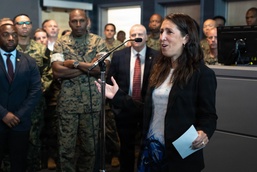
FORT GEORGE G. MEADE, Md. — The Honorable Katherine Sutton, Assistant Secretary of War for Cyber Policy and Principal Cyber Advisor to the Secretary of War, visited Marine Forces at Fort George G. Meade, Maryland, Aug. 28, 2026, to discuss the Department’s cyber priorities and U.S. Cyber Command’s CYBERCOM 2.0 implementation.
The visit gave Sutton an opportunity to meet with Marines and personnel responsible for carrying out department-level cyber priorities and identify areas requiring further coordination. She highlighted her vision for the Department to deliver the most capable, lethal, and agile cyber force in the world, in order to deter conflict, secure our strategic advantage, and defeat adversary aggression decisively.
She also highlighted the critical role of CYBERCOM 2.0, as it reimagines how the Department will forge and employ elite cyber warriors by placing greater emphasis on specialized personnel and training. The implementation focuses on deepening the speed and domain mastery of joint cyber capabilities while creating a structure that harmonizes collaboration throughout the force.
“The model fundamentally changes the Department’s approach to generating cyber forces, enabling increased lethality in our cyber forces and establishing a warrior ethos built on domain mastery, specialized skills, and mission agility,” Sutton said when the department announced the initiative in November of 2025.
During the visit, Sutton met with Lt. Gen. Joseph Matos III, deputy commandant for information, and Brig. Gen. Ahmed Williamson, commanding general of Marine Forces Cyberspace Command, Marine Forces Space Command, and Marine Corps Information Command. The Marine leaders gave Sutton an overview of current operations and how the command brings together capabilities across cyber, space and the information environment in support of CYBERCOM 2.0 objectives.
“The warfighting ethos and camaraderie Marines share are our greatest strengths, but we don't fight alone,” said Williamson. “We have to bring that same commitment to the joint force and work together across the services to build the most lethal cyber force possible.”
“To deter conflict and win decisively in cyberspace, we must invest deeply in our cyber forces,” said Sutton. “Our partnership with the Marine Corps is central to realizing the CYBERCOM 2.0 vision – building domain mastery, modernizing career pathways, fostering specialized skills, and delivering lethal, mission-ready cyber warriors to the joint force.”
Sutton met separately with enlisted Marines in the ranks of sergeant and below, along with officers in the ranks of captain and below. Marines provided feedback on their experiences supporting the Department’s cyber mission and implementing CYBERCOM 2.0 at the tactical level, including how training, career development and available tools affect their ability to execute the mission.
Artificial intelligence and data-driven operations were also a focus. Participants discussed how AI-enabled capabilities are being used and developed to support targeting, sensing and decision-making. The discussion also addressed what is needed to responsibly scale those capabilities.
“The future of cyber warfare depends on pairing talented warriors with agile, data-driven technologies,” said Sutton. “The speed at which Marines are operationalizing artificial intelligence provides a blueprint for the joint force, and we are committed to removing institutional barriers, so our operators have the advanced tools to outpace any adversary.”
The visit concluded with a discussion of implementation milestones and support requirements, as well as how the Marine Corps, U.S. Cyber Command, and War Department cyber policy leaders will continue to create a more lethal and masterful cyber force.