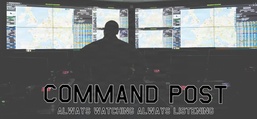
JOINT BASE LANGLEY-EUSTIS, Va. -- Behind every sortie, emergency response and installation decision is a command-and-control network designed to keep information moving and leaders informed.
At Joint Base Langley-Eustis, All Domain Command and Control Operations, commonly known as the command post, provides that connection around the clock, linking installation leaders, operational units, higher headquarters and national command authorities.
The command post serves as a central hub for time-sensitive information, helping leaders maintain situational awareness and make informed decisions during routine operations, emergencies and contingencies.
“We don’t have a typical day,” said U.S. Air Force Master Sgt. Lucas Drake, 633d Air Base Wing command and control operations superintendent. “It’s all dependent on what’s occurring on the base and what current operations look like.”
That unpredictability requires controllers to maintain constant readiness. During each shift, they monitor multiple information sources, maintain proficiency through recurring training and remain prepared to transition immediately from routine operations to emergency response.
At JBLE, that responsibility extends across a joint installation supporting Air Force, Army and mission partners whose operations contribute to missions around the world. The command post connects those local operations to the broader command-and-control enterprise, ensuring critical information reaches the appropriate decision-makers when time matters most.
“Even when the base appears quiet, the command post remains vigilant,” said Dave Harvey, 633d ABW command and control operations chief superintendent. “We don’t close for hurricanes or when overseas operation centers have been attacked. We stay, we do the job, and if we have to move to continue the command and control mission, we move.”
That ability to maintain command and control during degraded conditions is critical to installation and operational readiness. Controllers monitor activities ranging from flight operations and severe weather to emergencies requiring coordination among installation leadership, first responders, local agencies and higher headquarters.
“There are certain mission-essential functions within the military and the federal government that have to happen no matter what,” Drake said. “The biggest one is command and control. Without command and control, information does not move up and down the chain and you end up with thousands of different organizations fragmented, doing their own thing.”
The mission at JBLE reflects a broader Air Force requirement to maintain reliable command and control across installations, operational theaters and organizational boundaries. By providing trained personnel capable of rapidly receiving, assessing and transmitting information, command posts help preserve continuity of operations and connect tactical activity at the installation level with operational and strategic decision-making.
For Harvey, a former enlisted U.S. Army soldier and Air Force Airman, serving in both branches has shaped his perspective on the Air Force command-and-control mission.
“The Air Force does command and control better than the other services because we have an actual career field dedicated to it,” he said. “Because of our expertise, Air Force controllers frequently support joint operations across the Department of War.”
That expertise also requires controllers to operate effectively across different missions and organizations. According to Drake, Air Force command posts adapt to the supported mission while maintaining the procedures and readiness necessary to keep information flowing through the chain of commands.
Training and exercises reinforce that capability by requiring controllers to execute the same responsibilities expected during real-world operations.
“We run everything like it’s real,” said Drake. “When the installation goes into an exercise, nothing changes for our controllers. They are trained and ready…whether is it a daily task or for events they hope never occur. They will get the job done.”
Whether supporting daily flying operations, responding to an installation emergency or maintaining command and control during a contingency, JBLE controllers provide a continuous link between commanders and the forces they lead. That 24/7 capability helps ensure the installation remains ready to respond, sustain operations and support the broader Air Force and joint mission whenever called.