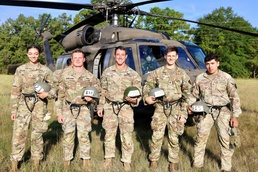
FORT RUCKER, Al. — Five soldiers from Fort Rucker graduate this week from the Army National Guard Warrior Training Center’s Air Assault School, completing 10 days of demanding instruction that tested their endurance, confidence and attention to detail.
The graduates are Pfc. Gianna Verdone, a 42A assigned to the U.S. Army Aviation Center of Excellence G-1; Warrant Officer 1 Matthew McWilliams and Warrant Officer 1 Austin Green, both Apache student pilots with 1st Battalion, 145th Aviation Regiment; Spc. Kayden O’Brick, an air traffic controller at Lowe Army Heliport with the 110th Aviation Brigade; and Sgt. Nicholas Parra, a combat medic from Lyster Army Health Clinic.
They trained alongside more than 200 soldiers from across the Army.
McWilliams said the course quickly showed why it is known as “the toughest 10 days in the Army.”
“It’s definitely been a challenge,” he said. “Sling-load operations. I didn’t know much about that until I got here. The cadre are extremely professional. There’s only six or seven of them, and they run 200 of us through the course.”
For McWilliams, who previously completed Airborne School during a hold in his training pipeline, Air Assault School provided his first close look at large-scale Army operations.
“As a brand-new street-to-seat guy, this was my first big dose of how the Army really is,” he said. Verdone said the course pushed her beyond what she expected.
“I came here and surprised myself,” she said. “All you can do is really try, do the best you can and see how far you can go.”
On the eve of the school’s 12-mile ruck march, the group reflected on helicopter rappelling, one of the course’s most intimidating events.
“I think that’s going to be the most nerve-wracking, seeing the blades spinning up top,” O’Brick said. “But once you’re off, it’s all training, everything we’ve learned the last couple days.”
Parra said the rappel was unfamiliar territory.
“I’ve practiced hoist operations in training, but never the real thing,” he said. “I’m excited.”
O’Brick said the course’s emphasis on load inspection and cargo movement stood out most.
“This what the school is really meant to be about, inspecting loads, transporting cargo and equipment, and making sure everything is right,” he said. “They teach you what right looks like, what wrong looks like, and how to fix it.”
Green, who previously served as an avionics technician in the 160th Special Operations Aviation Regiment, said the course gave him a broader understanding of the ground forces he will support as an Apache pilot.
“It was challenging to learn a new skill in a short amount of time,” he said. “Even if sling-load operations aren’t something an Apache pilot does every day, you see what it’s like on the ground. It helps you become a more well-rounded soldier.”
The five Fort Rucker soldiers will return to their units with new skills, a deeper understanding of air-ground integration, and the confidence that comes with completing one of the Army’s most physically demanding schools.
Their graduation also reflects a growing number of aviation soldiers using professional development opportunities during training-pipeline holds to broaden their experience and strengthen ties between aviators and the soldiers they support.