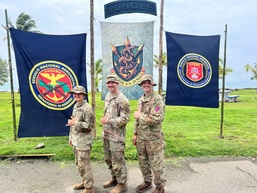
CRISTOBALl COLON, PANAMA — For three South Carolina Army National Guard Soldiers, the Jungle Operations Training Course-Panama provided more than an opportunity to operate in a different environment. It challenged them to adapt tactics, movement and decision-making to conditions that can affect how a unit fights.
U.S. Army Staff Sgt. Daniel Brew, an infantryman and rifle squad leader with Company C, 4th Battalion, 118th Infantry Regiment; Sgt. Brock Davis, an indirect infantryman assigned to Headquarters and Headquarters Company, 4th Battalion, 118th Infantry Regiment; and Spc. Aurora Pennington, a combat engineer assigned to the 174th Engineer Company, recently completed the course on July 3, 2026.
The Soldiers were selected by their leadership to attend Jungle Operations Training Course-Panama, known as JOTC-P, where they trained in jungle movement, survival techniques, land navigation and small-unit tactics.
The training required Soldiers to account for factors that can directly affect how a formation moves and fights.
“The jungle definitely changes how you operate and fight,” Davis said. “The jungle provides limited visibility, limited space and unpredictable weather to move and maneuver.”
Brew said a three-day patrol before the final “Green Mile” required students to apply their training during an extended field training exercise while carrying combat loads.
“Land navigation in the jungle can be exceptionally harder due to the thick vegetation,” Brew said.
The terrain also required Soldiers to adjust how they moved through the environment. Davis said the course demonstrated the importance of adapting tactics and developing squad-level standard operating procedures based on the conditions.
During the culminating exercise, or CULEX, Davis said the training became particularly relevant.
“Once you step into the canopy for your CULEX and put the tactics learned to use, you see how they apply strictly to the jungle environment,” Davis said.
The exercise incorporated tracking and counter-tracking techniques and demonstrated how limited visibility can affect movement and create opportunities for an enemy to conduct an ambush.
For Pennington, the course demonstrated how environmental factors can influence a unit's ability to respond to unexpected situations.
“Traditional environments often allow room for error, but the jungle punishes every mistake,” Pennington said.
Heat, rain, insects, terrain and limited visibility required Soldiers to continuously assess their surroundings and maintain themselves and their equipment.
Brew said hydration became a constant consideration, while his squad also encountered several nests of African killer bees during a patrol.
Night operations presented another challenge. The dense canopy limited ambient light, even while using night-vision equipment.
“Even under night vision, the canopy blocks many if not all ambient light,” Brew said. “Without running an infrared flood light, one could not see the back of their hand. So it would seem that the jungle really owns the night.”
The course also exposed the Soldiers to different approaches to small-unit operations. Pennington said she trained alongside Rangers, Sappers, Marines, MARSOC personnel and Panamanian soldiers.
“The variety in experience in each squad added so much value to training,” Pennington said. “Getting to learn from people with so many different backgrounds and specialties added a level to the training that we don’t often get the opportunity for in the National Guard.”
The Soldiers said the experience provided skills and perspectives they can bring back to their South Carolina formations.
Brew said rope systems, survival techniques and jungle-specific drills can be incorporated into infantry training. Davis said he plans to bring back different perspectives and ideas for squad-level training.
The training also contributes to readiness by giving Soldiers experience adapting their warfighting skills when standard assumptions about terrain, visibility and movement no longer apply.
“If we find ourselves deployed to an environment like this we will have a lot more insight into that situation than what we can bring back to a normal drill weekend,” Pennington said. The Soldiers recommended physical preparation for future JOTC-P students, particularly for operating in heat and carrying a ruck over extended periods.
Brew's advice for Soldiers considering the course was direct: “Show up, be an attentive learner, when in charge, be in charge, and put out.”
For the South Carolina Soldiers, the training provided another opportunity to develop the adaptability, fieldcraft and small-unit skills necessary to remain effective when operating conditions change.