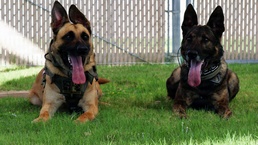
Whether conducting patrols, detecting explosives or supporting law enforcement operations, military working dogs assigned to the Provost Marshal's Office at Marine Corps Logistics Base Barstow serve as trusted partners in protecting the installation and the people who live and work aboard it.
Paired with specially trained handlers, military working dogs play an essential role in supporting force protection, public safety and mission readiness. Their highly specialized training, discipline and keen instincts make them a vital asset in maintaining security across the installation and throughout the surrounding region.
“Most people think that these are just ‘drug’ or ‘bomb’ dogs, but they are so much more than that,” Sgt. Taylor Purdy, MWD handler and trainer, said. “The implementation that we put into their training, which we are now focusing into more socialization for them, is imperative to that trust and companionship you build with your dog; they are ready to work from the moment we open that kennel door, so we have to be just as ready.”
The journey of a MWD begins long before arriving at MCLB Barstow. Selected for their temperament, intelligence and drive, the dogs complete rigorous training that prepares them for patrol, obedience, controlled aggression, building searches, area searches and explosive or narcotics detection. Once paired with a handler, training becomes a daily commitment as the team develops the trust and proficiency required to respond to a wide variety of operational scenarios.
“All MWD’s are trained at Lackland Air Force Base, Texas, where they get basic skills training. Once they arrive at duty station, they continue training every day to ensure they meet the minimum level of proficiency,” said Lt. Christopher Dixon, kennel master. “After minimum level is reached, we increase their training in both patrol and detection capabilities. The handler and trainer are key elements of making the dog successful or unsuccessful. The handler needs to do training every day with their dog to make them a good team.”
That relationship between handler and dog extends far beyond training.
Every patrol, exercise and mission strengthens a partnership built on trust, communication and mutual confidence. Handlers are responsible not only for employing their canine partners during operations but also for their daily care, physical conditioning and overall well-being.
“The dogs don’t know what they don’t know, just like any other Marine or person,” said Sgt. Jorge Bosquez Jr., MWD handler. “We have gone long days and 24/7 together; he eats when I feed him, he drinks when I give him water, so he depends as much on me just like I depend just as much on him when looking for explosives.”
Military working dog teams support a variety of missions both on and off the installation. On base, they conduct routine patrols, support installation access control, assist during special events and provide specialized detection capabilities that enhance force protection.
Beyond MCLB Barstow, the teams frequently support neighboring military installations and civilian law enforcement agencies upon request. Their ability to detect drugs, or explosives, and provide specialized patrol capabilities strengthens regional partnerships while helping protect surrounding communities.
“On base, it is sheltered and we have a home advantage versus on the outside, there’s a no control variable that brings a very different environment for them,” Bosquez said. “Outside of base, their (the dogs’) senses are firing on all cylinders because of the different smells, sounds, even animals, so they are able to experience something different and heighten their reliability even more.”
Although much of their work occurs behind the scenes, military working dogs are often among the first assets called upon during situations that require specialized detection or heightened security measures. Their capabilities help reduce risk to Marines, civilian employees and the public while providing commanders with an additional layer of protection during routine operations and high-profile events.
Installation leaders emphasize that military working dogs are more than operational assets—they are trusted teammates whose contributions directly support the installation's mission and the safety of everyone who works and lives aboard the base.
“The MWD’s are both a patrol dog and a detection dog. Their value is in walking patrols (being seen by public), psychological deterrent (physically at gate with MWD presence) and sweeps of buildings and vehicles for drugs/explosives,” Dixon said.
Like the Marines and civilian personnel they serve besides, military working dogs eventually reach retirement after years of dedicated service. Retirement is determined by factors such as age, medical condition and the dog's ability to safely perform operational duties.
For handlers, retirement represents both a proud accomplishment and an emotional milestone.
“At first, it is a tough adjustment, and for the first two months he had a lot of anxiety whenever I would leave the house,” Purdy explained, sharing from her personal experience of adopting Thor, former MWD from MCLB Barstow. “The hardest part for them is getting out of that working mind and realizing that they now have time to enjoy just being a regular dog; now he is just a big goofball!”
When a military working dog retires, every effort is made to provide the dog with a loving home. In many cases, the handler becomes the first choice for adoption, allowing a partnership built through years of service to continue into retirement. If the handler is unable to adopt, qualified families may be considered, ensuring each dog transitions from a life of service to one of comfort and companionship.
The retirement of a military working dog marks the conclusion of a distinguished career, but not the end of its legacy. The dedication, loyalty and service these dogs demonstrate throughout their lives leave a lasting impact on the Marines, civilian law enforcement officers and communities they protect.
Whether searching for explosives, or drugs, patrolling alongside their handlers, or participating in community demonstrations, military working dogs exemplify the Marine Corps' commitment to readiness, service and protecting others. Their careers may one day end in retirement, but their legacy lives on through the lives they safeguarded, the missions they supported and the enduring bond they forged with those who served beside them.