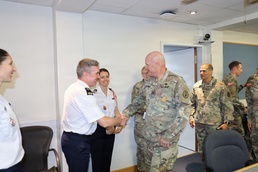
LANDSTUHL, Germany— Landstuhl Regional Medical Center welcomed clinical specialists and leaders from France’sHôpital d’Instruction des Armées Percyfor a two-day reciprocal familiarization visit Aug. 31 and Sept.1 focused on trauma care, burn care and operational medical readiness.
The exchange brought U.S. and French military medical professionals together to compare clinical practices, examine operational standards, and strengthen cooperation across the full continuum of critical care.
Col. Claude Burnett, LRMC global health engagement director, said the visit was the latest step in developing bilateral relationship between LRMC and HIA Percy that began with a senior-level key leader engagement in France in September 2025.
"That initial partnership led to a small LRMC team visiting Percy this past April," Burnett said. "This week's visit brings things full circle. We’re excited to host the Percy team at LRMC to show them firsthand how we operate, from our clinical care and rehabilitation services to our medical technology, simulation labs, and broader military medicine mission."
In Apr 2026, LRMC sent a small, three-person multidisciplinary team to HIA Percy for an observation-based familiarization visit.
“The intent was to understand Percy’s organization, clinical capabilities, and approach to military medicine, with particular emphasis on areas such as burn and trauma care, critical care, and rehabilitation,” Burnett said.
The reciprocal visit gave the French delegation an opportunity to observe those same areas at LRMC and examine how the U.S. military health system prepares medical personnel to care for wounded, ill and injured service members.
French Army officer, a member of the visiting delegation, said the experience highlighted similarities between the two military medical systems.
"Getting hands-on in the simulation center was an incredible experience," French officer said. "Stepping through advanced trauma procedures from preparing and administering blood products to securing an airway through intubation really highlighted the realism of LRMC’s training and the high standard of care our systems both strive for."
He said LRMC’s facilities and experience caring for wounded, ill, and injured service members were particularly impressive.
“It was a privilege to tour the hospital, French officer said. “My colleagues and I observed that we share far more similarities than differences in our approach to healthcare, which is a direct reflection of our unified mission.”
Over the course of the visit, participants compared clinical practices and discussed how their organizations could work together more effectively in future operational environments.
“During those discussions, we identified several areas where our respective capabilities were highly complementary, particularly burn care, trauma and critical care, rehabilitation, and clinical readiness,” Burnett said.
Although the two organizations use different equipment, terminology, and administrative processes, Burnett said their underlying approach to military medicine is closely aligned.
For allied medical teams, that familiarity is critical to interoperability.
“Direct familiarization helps turn interoperability from a concept into something practical,” Burnett said. “It is one thing to know that an allied hospital has a particular capability. It is much more valuable to understand how that hospital operates, know the people on the other end of the relationship, and understand how each organization approaches stabilization, communication, documentation, specialty care, and follow-on treatment.”
Barnett said one of the most valuable aspects of the exchange was the opportunity to compare complete systems of care rather than individual procedures.
“The most significant takeaway was not a single technique, but the value of comparing entire systems of care,” Burnett said.
That knowledge becomes especially important when allied medical organizations must coordinate patient care during a crisis or large-scale operation.
“Interoperability cannot be improvised after casualties begin arriving,” Burnett said. “We have to build the relationships, understand one another’s systems, identify areas of compatibility, and learn how to communicate before a crisis.”
Reciprocal visits give both organizations an opportunity to understand not only where their systems align, but also where each brings unique capabilities and expertise.
“Reciprocal engagements are important because they build that familiarity in both directions and allow each organization to identify what the other does particularly well,” Burnett said.
The French officer said the visit demonstrated how closely aligned the French and U.S. teams are in their clinical philosophies and standards of care.
"Engagements like this strengthen our interoperability, ensuring that whether our medical teams operate independently or side-by-side in joint environments, our patients receive seamless, world-class treatment,” French officer said.
For LRMC, the exchange is also an investment in future readiness. Building personal relationships and understanding allied medical systems before an emergency can reduce uncertainty when speed and coordination become critical.
“I think the most important point is that this is about making interoperability real at the clinical level,” Burnett said. “It is one thing to know that an ally has a capability; it is another to know the people, understand their system, and know how our organizations could connect when time matters.”
The relationship between LRMC and HIA Percy continues to develop, but Barnett said reciprocal exchanges provide the foundation for enduring military medical cooperation.
“We are building familiarity and trust now so that, if we are ever required to work together under far more difficult circumstances, we are not starting from zero,” Burnett said.