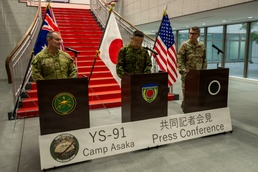
CAMP ASAKA, Japan — U.S., Japanese and Australian forces opened Yama Sakura 91 during a ceremony Sept. 2 at Camp Asaka, launching a trilateral command post exercise focused on readiness and interoperability.
Yama Sakura 91 brings together about 700 U.S. personnel, 5,200 members of the Japan Ground Self-Defense Force and 280 Australian Army personnel at locations across Japan and the United States.
“This is more than the 46th iteration of Yama Sakura,” said Lt. Gen. Matthew W. McFarlane, commanding general of I Corps. “Today, we demonstrate the strength of our alliance in a very real way.”
Unlike field exercises centered on maneuver, Yama Sakura focuses on decision-making, command and control, and staff integration. The exercise strengthens multinational coordination by aligning procedures, systems and planning processes among participating forces.
Yama Sakura links headquarters from the theater to division level, requiring commanders and staffs to coordinate capabilities and synchronize operations across multiple echelons.
U.S. participants include personnel from U.S. Army Pacific, I Corps, U.S. Army Japan and the 11th Airborne Division, working alongside the Japan Ground Self-Defense Force and the Australian Army’s 1st Division.
“This exercise provides an important opportunity to enhance the collective response capabilities and interoperability of Japan, the United States and Australia,” said Lt. Gen. Endo Makoto, commanding general of the Japan Ground Self-Defense Force Ground Component Command. “It contributes to the security of Japan and regional peace and stability.”
By working together, the three nations refine how they communicate, plan and operate while strengthening the relationships, technical compatibility and procedures needed for future crises or contingencies.
“Interoperability is not built through systems and procedures alone. It is built through people,” said Maj. Gen. Ash Collingburn, commander of the Australian Army’s 1st Division. “It comes from understanding how our partners think, how they make decisions and how they operate.”
Now in its 46th iteration, the exercise continues to evolve in scale and complexity, strengthening the ability of U.S., Japanese and Australian forces to operate together.
Yama Sakura 91 continues through Sept. 10.