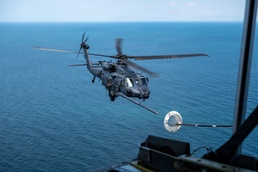
MOODY AIR FORCE BASE, Ga. -- Crews from the 41st and 71st Rescue Squadrons took part in a Combat Search and Rescue Task Force (CSARTF) exercise over the Gulf of Mexico, Aug. 26, 2026.
The exercise brought together the three components of the rescue triad—the HC-130J Combat King II, HH-60W Jolly Green II and Guardian Angel weapon system—to practice the tactics, techniques and procedures used during real-world combat search and rescue missions.
“This exercise and CSARTF sorties as a whole give all the players of the rescue triad a chance to work together and practice the tactics, techniques and procedures we will use in combat in a structured and permissive environment,” said Capt. Steven Griffin III, 71st Rescue Squadron pilot.
The training was designed to simulate the complicated and demanding conditions rescue crews could face in combat, including multiple isolated personnel, threats, long-range flight and aerial refueling. The mission began long before the aircraft left the runway. Crews spent approximately 10 to 12 hours in the Mission Planning Cell preparing for the sortie, reviewing intelligence, identifying threats, gathering survivor information and planning routes. In the end the sortie included one aerial refueling, the recovery of two survivors and responses to multiple simulated threats.
“As the pilot these scenarios mean long missions, low-level over-the-water flying and a big mental load,” Maj. Kayla Pipe, 41st Rescue Squadron pilot said. “While we all work together in the aircraft, the pilots are the ones on the controls. We are ultimately responsible for keeping everyone safe.”
Once airborne, the training scenario continued to evolve. One of the most demanding portions of the mission was helicopter air-to-air refueling, or HAAR. The HH-60W crews practiced receiving fuel from the HC-130J while operating at low altitude over the water.
The narrow margin for error makes HAAR a skill that requires consistent practice. Weather, turbulence, aircraft weight, altitude and experience can all affect the refueling process. One of the best ways to become proficient is simple: practice.
“The more you do HAAR the better and more comfortable you become,” Pipe said.
While the aircraft crews focused on maintaining precise flight and communication during refueling, the larger CSARTF continued operating around them.
“The main issue with aerial refueling in exercises is the larger battle does not stop while we are giving gas,” Griffin said.
The crews must continue monitoring the tactical situation, communicating with other aircraft and maintaining awareness of potential threats while temporarily dedicating personnel to the refueling operation. That integration is central to the CSARTF mission.
“Internal to the CSARTF there is an assumption that all other participants are doing their job,” Griffin said. “This frees up brain bytes and mitigates risk by ensuring the crucial information is heard.”
Trust is built through repeated integration between the 41st and 71st RQS, as well as the Guardian Angel teams which is comprised of Combat Rescue Officers, Pararescuemen and Survival, Evasion, Resistance and Escape (SERE) Specialists. Training together helps crews understand one another beyond simply knowing their roles.
“Relationships play a huge part of learning to build trust,” Pipe said. “When you personally know the A-10 pilot overhead, live next-door to someone in the HC-130 flying with you to pass fuel or play ping-pong with the PJs sitting in the back of your helicopter, things become more personal.”
The exercise also introduced unexpected challenges. Simulated pop-up survivors required crews to reassess their plans, calculate fuel requirements and determine whether additional recoveries were possible while continuing to account for the existing threat picture.
Weather added another real-world variable. Thunderstorms forced Pipe's crew to alter its route to the Gulf and added approximately 20 minutes to the flight. Those complications are intentional. CSARTF training is designed to force crews to adapt when a carefully planned mission no longer goes according to plan.
“We do an excellent job training and do our best to simulate real world dangers and threats, but there are some things you cannot simulate, and the enemy always gets a say,” Pipe said.
For Griffin, the lessons learned during these exercises can influence how future crews approach similar missions.
“From these iterations we develop lessons learned that can be applied so that when the next crews are faced with a similar scenario they can prevent the mistakes we made and ultimately pick up JACK in a more timely and safer manner,” Griffin said.
But beneath the aircraft, communications systems and tactical scenarios is the reason the rescue mission exists in the first place: the person waiting to be rescued. Training becomes more personal when crews consider that the person they may someday be sent to recover could be someone they know.
“When you know that you are going to rescue fellow Americans—ones you might have worked with previously, are friends with, went to college or pilot training with—things become personal and sometimes emotional,” Pipe said.
That connection is part of what drives the crews to take training seriously. Every exercise provides an opportunity to practice the procedures, build trust and learn from mistakes before those lessons are needed in combat. For the 41st and 71st Rescue Squadrons, the goal is not simply to complete the next training sortie, it is to be ready for the day when the scenario becomes real.