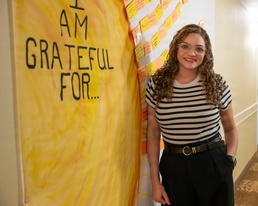
JOINT BASE LINDSEY GRAHAM, S.C. -- Having experienced her own lowest moments and helped loved ones through theirs, Anastasia Hill now stands in front of Airmen and civilians with a message shaped by experience and honesty: no one should have to struggle alone.
Hill spent more than two years learning and growing within the Air Force as a prevention specialist Palace Acquire intern. Suicide prevention is not just another annual requirement or presentation on a schedule – for Hill, it is personal.
“I’ve had to pull myself out of rock bottom,” Hill said. “I’ve had to pull other people up from their rock bottoms. Had someone not helped me, had I not helped someone else, I would have lost more people in my life.”
Earning her master’s degree in forensic psychology, Hill completed her education while balancing work, motherhood and everything else life placed in front of her. Her determination was most evident during the final days of earning her degree: Hill was in the hospital, in labor with her daughter, while finishing her final papers.
That determination continues to show in the way Hill approaches her work. She openly acknowledges that discussing suicide can be uncomfortable, but she believes discomfort should never outweigh someone’s safety.
“It’s not about my comfort,” she said. “It’s about what this person needs.”
That authenticity comes through in the classroom. Hill speaks with participants rather than at them, sharing personal experiences when she believes they can help others understand the importance of the conversation. She wants people to recognize that asking for help does not make them weak or less independent.
She knows firsthand how difficult that step can be.
For someone who once took pride in handling everything on her own, admitting she was struggling felt like failure.
Over the past several years, Hill has experienced financial challenges, job uncertainty, a cross-country move, the loss of her grandmother and the everyday demands of raising two young children. Through those moments, she learned the value of the people around her.
“Being able to say it out loud was so embarrassing,” Hill said. “It was like a failure for me.”
Now, she hopes to help change that mindset—especially within the military community.
Although Hill does not come from a military background, she has seen the unique pressures service members face. Military life can mean deployments, long periods away from family, demanding responsibilities and the challenge of balancing a personal life with a military career.
“You guys have to live two lives,” Hill said. “You have to live the military life and the personal life.”
For Hill, prevention means getting ahead of those challenges and reminding people that resources and support exist. She believes resilience is not about pretending difficult things do not hurt. It is about preparing for difficult moments and building the connections needed to get through them.
Hill’s hope for the future is a culture where people no longer feel ashamed to admit they are struggling. She wants conversations about mental health and suicide prevention to become more open, allowing people to seek help before they feel completely alone.
“I hope, at some point, people feel comfortable saying, ‘I’m really struggling right now.’” Hill said.
Hill hopes to continue this work after completing the Palace Acquire Program. Her dream has always been to share what she has experienced so that someone else may not have to go through the same pain, especially not alone. If sharing her story helps even one person, she believes it matters.
If there is one thing Hill wants readers to remember, it is the same message that has guided both her life and her work.
“It’s okay to not be okay,” she said. “Remember, this is temporary.”
For Hill, that message is more than a familiar phrase. It is the reason she is here to say it.
September is suicide prevention month. For more information call the numbers below.
Suicide and crisis lifeline call: 988
628th Medical Group call: (843) 963-6880