NPS STEM Internship Program Cultivates Next Generation of Defense Innovators By MCSN Katherine Eldridge
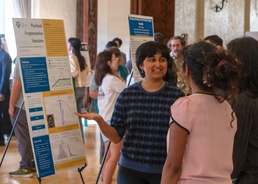
Nearly 70 high school, undergraduate and graduate students from across the country shared the results of their summer research internships with the Naval Postgraduate School (NPS) community during the 2026 NPS STEM Internship Research Showcase, Aug. 7, highlighting the university's commitment to developing the next generation of scientists and engineers who will support naval and national security.
The year-round program pairs student interns with NPS faculty mentors conducting original research, giving students hands-on experience while exposing them to potential careers within the naval research enterprise, according to NPS Director of STEM Activities Dr. Jennifer Carson. During the 2025-26 academic year, approximately 30 to 40 interns worked part time at NPS, with the program growing to 70 interns working alongside 25 faculty mentors over the summer.
For Carson, giving students the opportunity to contribute to work that serves a larger national security need is key to inspiring them to continue developing their STEM expertise and to considering careers within the defense research enterprise.
“Providing STEM experience and education to these interns, and fostering their interest in STEM careers, is not only good civic stewardship, it is vital to the continued health of the Navy,” Carson said.
Interns come to NPS through multiple pathways. Several were supported through two programs managed by the Office of Naval Research, the Science and Engineering Apprenticeship Program (SEAP) for high school students, and the Naval Research Enterprise Internship Program (NREIP) for college students. Additionally, dozens of summer cohort interns came through NPS regional partnerships with educational institutions, such as Monterey Peninsula College, Hartnell College and California State University, Monterey Bay, as well as NPS’ own Student Volunteer Program.
Across campus, interns contributed to research in mechanical and electrical engineering, materials science, space systems, physics, computer science, defense analysis, operations research, logistics and many other fields. Their work ranged from developing hardware and building circuits to writing code, testing new processes and supporting logistics for ongoing research.
One of those interns was Aarohi Joshi, a high school senior from Irvington High School in Fremont, California, who worked with NPS Department of Physics professor Joseph Hooper to develop a virtual warhead fragmentation simulator. Joshi’s project focused on creating a modern, in-house simulation program that tracks fragmentation characteristics such as mass, velocity and ejection angle and can be updated as new needs emerge.
“It’s not every day that a high schooler gets to work on a naval base, and especially not one as unique as NPS,” Joshi said. “Because it is both a naval base and a research institution, I found myself drawn to the opportunity to do challenging yet meaningful work.”
That opportunity placed Joshi directly into a complex research problem requiring knowledge across several disciplines. According to Hooper, developing the simulation required “an understanding of the physics at high loading rates, the mathematics of creating probabilistic output, and an ability to put it all together into a complete code package.”
“I was impressed with Aarohi’s ability to independently determine the next steps on the project and make headway on it without oversight,” he added. “For a high school student, that level of independent work and judgement is very impressive.”
The open-ended nature of the project also gave Joshi a different experience from the traditional classroom, where problems typically have defined parameters and expected outcomes.
“Conducting research at NPS has been different because almost everything done at NPS has both real-world applications and real-world consequences,” Joshi said. “At NPS, I am constantly finding new avenues to explore and improving my research.”
Hooper’s own connection to Navy STEM programs inspired his participation as a mentor, with his experience demonstrating how exposure to defense research can influence a student’s future professional path.
“I have a particular appreciation for the Navy STEM programs, as I began my own career in one during graduate school,” he said. “These programs give high-performing students an opportunity to engage in a piece of a larger R&D project they might be involved in were they to choose a career in this area.”
Beyond their individual projects, summer interns participated in weekly lectures, workshops and field trips designed to expose them to a broader range of STEM disciplines.
And some even supported work that extended beyond the NPS campus. Eleven interns’ research projects were in direct support of NPS’ Consortium for Advanced Manufacturing Research and Education (CAMRE) and its efforts during the Rim of the Pacific (RIMPAC) Exercise 2026 to operationalize advanced manufacturing.
For many participants, these summer internships are their first sustained exposure to NPS and the broader naval research enterprise. Carson said the experience is intended not only to develop technical knowledge and skills, but to also help students learn about the collaboration, communication and leadership skills required to work effectively on complex research problems.
As the summer concluded with the campus-wide poster session and awards ceremony, interns were given an opportunity to share what they had accomplished with the broader NPS community, and to reflect on how their understanding of Navy research had changed.
For Carson, the value of that exposure extends beyond whether an individual intern ultimately pursues a career with the Department of the Navy.
“They went from having little to no knowledge of NPS or Navy research, to being an enthusiastic advocate for both,” Carson said. “Even if a particular student doesn’t end up working for the Navy, every one of them leaves as an advocate for it.”
NPS, located in Monterey, California, provides warfighting-focused graduate education, including classified studies and interdisciplinary research, to advance the operational effectiveness, technological leadership and warfighting advantage of the naval service. Established in 1909, NPS offers master’s, doctoral and distance-learning certificate programs to U.S. Department of War military and civilian students, as well as to international partners, to develop warfighters and leaders who can think critically, solve complex operational problems and deliver mission-ready solutions through advanced education and research.