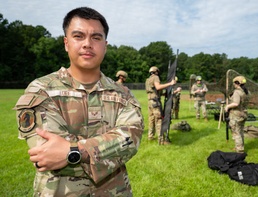
JOINT BASE LINDSEY GRAHAM, S.C. — The sun beat down on the training area as Airmen held their positions around the simulated base. Heavy equipment filled the yard, dust hung in the air and the weight of their protective gear pressed against them as they waited for the next detonation in the stifling heat. Boots shifted against the ground. Voices came through radios. Some Airmen scanned the surrounding area while others watched the people beside them, waiting for the next cue.
No one knew exactly when the next blast would come.
Around them, the exercise continued. Radios crackled as Airmen moved through the simulated environment, communicating with one another and responding to problems designed to test how they would react when familiar conditions disappeared.
U.S. Air Force Senior Airman Miguel Dee, 628th Air Base Wing plans and programs battlefield, assessment, and tactical training learning environment school cadre, watched from the edge of the training area. He helps prepare Airmen for the realities of operating in contested and deployed environments.
But tactical training had not always felt relevant to him.
From where he stood, Dee was reminded of the uncertainty he once felt himself. As an aerial port Airman, he was accustomed to a mission centered on cargo. He worked with the movement and handling of equipment and supplies, making sure cargo reached where it needed to go to support the mission.
For Dee, the question was simple.
Why would an aerial port Airman need tactical training?
“I’m a port dawg by trade, so I always wondered, ‘What do I need this for? When am I going to be in this situation?’” Dee said.
Tactical training felt different.
Now, he teaches it.
On the training ground, Dee moved between the groups, watching the Airmen as they worked through the scenario without immediately intervening. When one team struggled, he waited. The Airmen talked through the problem, adjusted their approach and tried again. Only when they needed direction did Dee step forward.
“I never thought I would be an instructor,” Dee said. “Teaching isn’t really in my nature. Being in front of a lot of people sometimes makes me nervous.”
The role pushed Dee outside his comfort zone, but those who worked with him saw potential in the Airman standing in front of the class.
Staff Sgt. Barbara Brun, Dee’s former supervisor in the 437th Aerial Port Squadron Cargo Services section, saw something in him that Dee didn’t necessarily see in himself.
“I recommended SrA Dee to become a BATTLE school instructor because he's a dedicated, hard-working Airman who naturally stands out as a leader among his peers,” Brun said.
Dee’s experience in the role has required more than simply learning how to teach. It has required him to make decisions, communicate clearly and recognize when to lead from the front and when to let others take over.
“During deployment, SrA Dee demonstrated elite potential by training his shift and leading critical missions,” Brun said. “Back home, he seamlessly assumed the Cargo Handling Supervisor role during my absence, keeping the team focused and mission-ready.”
Those experiences helped shape how Dee approaches instruction.
“It’s more than just knowing how to do the job,” Dee said. “You have to be able to make decisions, adapt and support the people around you.”
As Airmen move through the training scenarios, he focuses on more than whether they complete each task correctly. He wants them to understand what they are doing well enough to make decisions when the situation changes.
“We’re teaching them to build a foundation and from there go to the next step,” he said. “Once they have that foundation in place, they can act independently.”
For Dee, the goal is not simply another requirement checked off. He wants Airmen to understand why they are learning a skill and have the confidence to use it when circumstances change.
But preparing Airmen means more than teaching them how to respond to a threat.
Some of the most important lessons happen in the relationships Dee builds with the people he teaches.
Not every Airman arrives at training worried only about the next scenario. Dee has also interacted with Airmen preparing to leave home for the first time, facing the uncertainty of a new environment and the possibility of being separated from the people they love.
For some, the unknown can be just as intimidating as the training itself.
Dee drew from his own experiences and offered reassurance to the Airmen.
“For me, it’s more about the people you’re with rather than the job,” he told the interviewer. “Be there for them and have their backs.”
The advice reflects the same approach Dee brings to BATTLE school. Skills provide the foundation, but people provide the strength to operate when conditions are unfamiliar.
“It’s a great opportunity for me to meet a lot of people, share those experiences with them, and also be the one who helps them or gets them prepared for their upcoming expedition,” Dee said.
Brun said Dee's ability to build those relationships is central to his leadership.
“His defining strength is his ability to build a cohesive, trust-based environment where Airmen support one another and execute the mission with confidence,” Brun said.
The Airman who once wondered why he needed tactical training now helps others understand why they might.
Around him, Airmen continue moving through the training area, working through problems they may one day face somewhere far from home. The questions may be different, the environments may be unfamiliar and the circumstances may change, but Dee wants them to leave with something that can carry into any situation: the confidence to rely on their training and the people beside them.
What once felt like a question about his own job has become another way for Dee to prepare the people around him.
“You’re not alone,” Dee said. “I’m always here for my Airmen.”