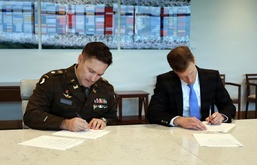
CHARLESTON, S.C. — The U.S. Army Corps of Engineers, Charleston District, and South Carolina Ports Authority officially launched a new feasibility study today aimed at evaluating navigation improvements along the upper Charleston Harbor.
Lt. Col. Todd Mainwaring, Charleston District commander, and SC Ports President and CEO Micah Mallace signed a feasibility cost sharing agreement at the SCPA Headquarters in Mount Pleasant, South Carolina, Aug. 28. The agreement marks the formal start of an in-depth engineering, economic and environmental study to evaluate potential improvements to the Cooper River navigation channel that serves the North Charleston Terminal.
The Upper Channel is currently maintained at a depth of 48 feet. Deepening this area could create a uniform depth throughout Charleston Harbor, enabling modern container vessels to navigate the entire port system without tidal restrictions.
The effort builds directly on the successful partnership that delivered the Charleston Harbor Post 45 Deepening Project in 2022, which made Charleston the deepest harbor at the time on the East Coast at 52 feet and opened unrestricted access to the Wando Welch and Hugh K. Leatherman terminals.
“Building on the success of the Charleston Harbor Post 45 Deepening Project, the Charleston District looks forward to continuing our collaboration with the South Carolina Ports Authority and stakeholders to evaluate options for improving navigation and to strengthen the economy of South Carolina and the nation,” Mainwaring said.
As the nation’s leading federal agency for water resources infrastructure, USACE maintains and improves commercial waterways to facilitate safe, reliable and cost-effective maritime commerce.
Congress authorized the new feasibility study in the Water Resources Development Act of 2024, and appropriated federal funding to initiate the investigation. Under the terms of the agreement, SC Ports will share the study’s costs as the non-federal sponsor.
“SC Ports, the U.S. Army Corps of Engineers, the S.C. Legislature, and the Congressional delegation worked together for more than a decade to successfully deepen Charleston Harbor, giving South Carolina a lasting competitive advantage,” said Bill Stern, SC Ports board chairman. “This next deepening effort aligns with the port’s mission to deliver projects that support economic growth and jobs throughout South Carolina.”
During the study phase, USACE planners and engineers will analyze navigational channel efficiency, vessel traffic projections and environmental impacts to formulate sustainable solutions that support national economic development.
Jacob Kyzar, Charleston District project manager for the study, said the study is about partnerships and collaboration. “We are working together to better understand the needs of the region and will make an assessment of the best path forward once the study is complete.”