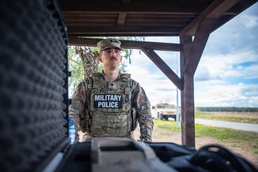
PABRADĖ TRAINING AREA, Lithuania — The drone was already in the air when the instructor told the Soldiers to close their eyes.
They stood with the anti-drone weapon system held low, listening. Then: open, spot, engage. One Soldier found the aircraft soaring through the sky, brought the emitter up, and put it on jam. The drone dropped.
That drill—find it fast, kill the link, keep jamming until somebody clears the site— was the heart of a day of counter-drone training here Aug. 27th, where military police and other Soldiers qualified on a DroneBuster,a handheld counter-drone electronic warfare system under the Fixed Site-Low, Slow, Small Unmanned Aircraft Integrated Defeat System team.
The team owns the airspace over this installation.
"We make sure that no drones are flying over the base or around the perimeter," said 2nd Lt. Maisa Faasa, the FS-LIDS officer in charge, assigned to the 2nd Battalion, 3rd Field Artillery Regiment, 1st Armored Division. "We deter any drones that do, or we engage them and bring them down."
The team is small by design. The answer to that math is to put the capability in everyone's hands.
"When one person is qualified to deter drones, it's nice," Faasa said. "But when multiple people are qualified to deter drones, it's even better for the security of not only the force itself, but the surrounding areas as well."
Friday's instruction was led by Cpl. Aaron Goolsby, of 2-3 Field Artillery, a Soldier who learned the system on this rotation and now teaches it. That progression is the model.
"The more people who know, the better," Faasa said.
The threat drives the urgency. Small unmanned aircraft fly reconnaissance, carry payloads, and increasingly do not need a hand on the controls.
"Drones are very dangerous," Faasa said. "They could carry payloads, they can do reconnaissance, they could do anything. Not all the time do they need to be manned."
For the military police, the training lands directly on the job.
"We're actually one of the response teams," said Spc. Dakota Berger, of the 603rd Military Police Company. "If there's ever any drone sightings in the area at all, we will always respond. So we need to know how these systems work and what kind of drones we could expect."
Soldiers ran the fundamentals: detection range, jamming range, what the system sees and what it doesn't, then moved to live engagements. Instructors drilled the follow-through hard: keep the emitter on the aircraft after it lands, because a dark drone is not a dead one, then cordon the site, treat it as unexploded ordnance and get explosive ordnance disposal forward.
The gear, Berger said, rewards the reps.
"Once you get the settings right, it's just point and click, and it jams it for you."
What the day produced was reach; more Soldiers who can act on contact, in more places, without waiting.
"I think this is a skill that every MP needs to know. Honestly, almost every Soldier should know it," Berger said. "There's going to be situations where the answer to the drone is going to be who's closest, who can respond the quickest, and that's what will save lives."