JOINT BASE LEWIS-MCCHORD, Wash. – The U.S. Army's medical logistics supply chain is undergoing its most significant transformation in decades. The message to commanders is clear: The friction of change is real, but the payoff is true battlefield readiness.
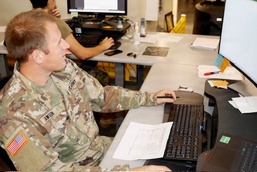
In early August, leaders gathered at Joint Base Lewis-McChord for the Medical Logistics in Campaigning, or MiC, Wave 4A Rehearsal of Concept drill. Led by U.S. Army Medical Logistics Command, MiC integrates medical logistics into Global Combat Support System-Army, or GCSS-Army, optimizing Class VIII supply and maintenance while separating operational capabilities from Defense Health Agency processes.
Currently, about 65% of Army medical units are operating within the MiC construct. With the start of Wave 4, which encompasses I Corps, U.S. Army Pacific, Army National Guard Regions IV, VI and VII, and the Forward Repair Activity-Medical site coming online at JBLM, the Army is on track for 98% integration by January 2027.
Still, MiC leaders acknowledge that bridging the gap between unique medical supply systems and conventional Army sustainment is not without its challenges.
Acknowledging gaps
Historically, legacy systems like the Defense Medical Logistics Standard Support and Theater Enterprise-Wide Logistics System isolated medical units from the broader Army sustainment picture. Bringing Class VIII into GCSS-Army puts medical supply on the same digital shelf as repair parts and rations.
While this standardizes processes for large-scale combat operations, or LSCO, the transition has caused longer initial lead times and cataloging hurdles as the enterprise aligns with Defense Logistics Agency sourcing.
“To truly train as we fight, we must operate in garrison exactly as we would downrange,” AMLC Commander Col. Deon Maxwell said. “Our legacy systems did not allow for that. By fully integrating into the Army’s standard sustainment enterprise, we ensure our Soldiers rely on the exact same tools at home station that they will use in combat.”
Senior leaders at the two-day ROC drill did not sugarcoat the strategic challenges of this transition.
Col. Erin Miller, deputy commanding officer for sustainment at I Corps and commander of 593rd Expeditionary Sustainment Command, urged leaders to push through the friction.
“We are very comfortable in doing the things that we have done and how we've done them,” Miller said. “There is reluctancy for change to move into the future. But change is good. This is incredibly important for our Army, for our warfighters, that we get this right.”
Lt. Col. Travis Helm, operations chief for AMLC and project manager for the MiC effort, echoed those statements, recognizing the “growing pains” that come with new procedures and processes.
“We acknowledge there are strategic wait times that are longer than ideal, but some units are showing signs of success and embracing the new way of doing business,” he said.
Controlling tactical space
While strategic sourcing processes are being refined nationally, medical and sustainment leaders at the offsite pivoted focus to what units can control tactically.
Helm acknowledged the steep learning curve associated with adopting a new enterprise system, alongside the reality of extended shipping times. However, he noted this presents a major opportunity for units to influence their own success, as roughly 45% of overall customer wait time occurs at the unit level.
Because the procedures are still new for many and specific actions are necessary, orders can inadvertently get stuck in the local release phase or await post goods receipt at the local supply support activity, or SSA.
By refining these receiving processes and getting familiar with the system, units can drastically cut down on their own wait times.
“We have to focus on what we can impact and improve to shorten up those wait times,” Helm said.
To combat this, the ROC drill focused on best practices for units, such as improving release strategies and completing authorized stockage list, or ASL, analysis that will enable units to get after challenges.
Helm specifically highlighted the 1st Special Forces Group (Airborne) as a prime example of doing it right. By embracing the challenge and conducting their own internal analysis, the unit expanded its ASL by roughly 100 lines and successfully processed $115,000 in deployment orders with zero cancellations.
Chief Warrant Officer 3 Peter Kuch, SSA accountable officer for the group, attributed that success to building daily “sets and reps” in GCSS-Army and rotating medical logistics specialists directly into the SSA to work alongside automated logistical specialists.
“It was daunting at first, but with consistent sets and reps, routine operations got much easier and became second nature for our Soldiers,” Kuch said.
Other priorities include embracing a “crawl, walk, run” approach. While implementing units have expressed concern that storage requirements can be complex and expensive, experts from the U.S. Army Health Facility Planning Agency clarified that initial operational capacity can happen with existing resources, beginning simply with crossdocking operations and field refrigerators, for example, rather than waiting for expensive warehouse renovations.
Cross-training remains equally critical to that self-reliance. I Corps is already applying this model by also having its medical logistics and supply technicians cross-train directly with 1st Special Forces Group, while the U.S. Army Medical Center of Excellence has bolstered this with a hybrid “train-the-trainer” approach. Additionally, units are seeing massive success by physically integrating their MEDLOG officers directly into logistics shops.
Leaders emphasized that training efforts could further empower units to leverage GCSS-Army’s bill of materials tool, accurately load sets, kits and outfits to establish a real-time common operating picture of medical readiness.
Accurately tracking this data allows commanders to seamlessly dictate funding priorities and shortage fills.
Helm noted units like the 30th Medical Brigade, of U.S. Army Europe and Africa, are operating “leaps and bounds” ahead of others by aggressively aligning their components. Since implementing MiC on April 1, the unit has achieved the highest rate of medical equipment set updates in GCSS-Army.
“The center of gravity is the IT systems,” said Jim Waddick, a logistics management specialist with Army Materiel Command’s G-3. “If you are using the bill of materials tool and have your inventory loaded into GCSS-Army, then the system starts working as it is supposed to with demand signals.”
Preparing for the Pacific
For units operating in U.S. Pacific Command, the urgency of MiC is amplified by the extreme distances and austere environments.
Relying on commercial air or standard shipping is a luxury that may not exist during a crisis west of the International Date Line. By forcing medical logistics into the standard Army supply chain today, the enterprise is setting the conditions to utilize joint theater distribution centers. These are multi-commodity SSAs positioned forward in places like the Philippines and Japan.
Ultimately, the sentiment throughout the ROC drill was clear: While strategic leaders aggressively work to close key gaps and shorten lead times at the strategic level, the operational force has tremendous ground to gain by fully embracing the transition and driving efficiencies in the areas they control.
“Collectively, I think we just have to come together and figure out how to make it work,” Miller said. “If you run into a roadblock, let’s figure out how we either navigate around the obstacle or, quite frankly, blow a hole through it and go right to the objective.”