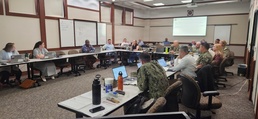
NEWPORT, R.I. — Naval Medical Forces Atlantic concluded the fourth and final installment of its fiscal year 2026 Expeditionary Medicine Operational Planning Team series at the U.S. Naval War College, advancing efforts to improve how Navy Medicine generates, resources, sustains and commands expeditionary medical forces for Fleet operations, Aug. 24-28, 2026.
The three-day work group culminated in a three-phase planning effort focused on identifying and resolving barriers that can affect the Navy’s ability to rapidly employ expeditionary medical capabilities where and when operational commanders need them.
In alignment with the Chief of Naval Operations’ Fighting Instructions and the Naval Expeditionary Health Service Support Concept of Operations, participants moved beyond identifying operational friction points to developing practical solutions for force generation, sustainment and command and control.
“Expeditionary medicine has to be ready to move at the speed of the Fleet,” said Cmdr. Ray Posey, NMFL deputy chief of staff for requirements and capabilities and deputy director for Maritime Operations. “This series brought together the organizations responsible for generating, resourcing and employing these capabilities so we can reduce friction before our medical forces are called to deploy.”
The event brought together operational planners, clinicians, resource sponsors and warfighting educators from across Navy Medicine and supporting organizations, including the Office of the Chief of Naval Operations, Bureau of Medicine and Surgery, Naval Medical Forces Atlantic, Naval Medical Forces Development Command, Naval Medical Forces Pacific, Navy Medicine Readiness and Training Commands, Naval Expeditionary Medicine Warfighter Development Command, Naval Medical Readiness Logistics Command, and Expeditionary Medical Facilities.
Across the four-part series, participants developed several tools and recommendations designed to improve expeditionary medical readiness, including a standardized EXMED demand signal tool that gives Fleet planners a clearer way to identify required medical capabilities and support; standardized materiel-management procedures for equipment accountability, lifecycle management and inspections; and a financial planning framework that clarifies funding requirements throughout force employment. The team also developed a concept of support for small arms and ammunition to strengthen force protection and sustainment for deploying medical units and examined a force-design model intended to provide more responsive command and control of expeditionary medical capabilities.
Together, the efforts address critical components of expeditionary force generation — identifying the requirement, assembling the capability, resourcing and equipping the force, sustaining it, and establishing the command relationships necessary for employment.
The final session in Newport provided participants with an opportunity to examine how those processes must function in contested and distributed environments, where medical forces may be required to operate with limited logistics, communications and evacuation options.
“To maximize survivability and preserve combat power in a contested environment, our expeditionary medical systems must be organized, trained and resourced as agile naval warfare capabilities,” Posey said. “The consensus built here at Newport sets the vector for the future fight.”
The completion of the FY26 OPT series provides NMFL and Navy Medicine leaders with actionable recommendations to inform future decisions on expeditionary medical force development and employment, strengthening Navy Medicine’s ability to deliver ready medical capabilities in support of the Fleet and Fleet Marine Force.
NMFL, headquartered in Portsmouth, Virginia, delivers operationally focused medical expertise and capabilities to meet Fleet, Marine and Joint Force requirements by providing equipment, sustainment and maintenance of medical forces during combat operations and public health crises. NMFL provides oversight for 21 NMRTCs, logistics, and public health and dental services throughout the U.S. East Coast, U.S. Gulf Coast, Cuba, Europe, and the Middle East.
Navy Medicine's 44,000+ talented and ready forces optimize health readiness, deliver quality healthcare, and provide global expeditionary medical support to warfighters.