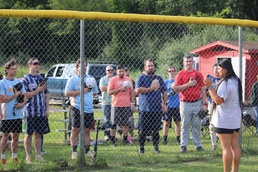
PICATINNY ARSENAL, N.J. - When the workday ends and the sun begins to set behind the Picatinny landscape, the crack of a softball bat can once again be heard echoing across the installation’s baseball diamond as fans cheer from behind the first base fenceline.
This vibrant scene of morale and teamwork between servicemembers, employees, retirees, and family members is largely thanks to the tireless, off-duty dedication of one U.S. Army civilian employee.
Elizabeth Chang, a U.S. Army Combat Capabilities Development Command (DEVCOM) Armaments Center Executive Fellow initiated the revitalization of the installation’s softball league, transforming it from a dormant program into a cornerstone of community and camaraderie.
The Picatinny Softball League, which initially began as a baseball league nearly 100 years ago, fizzled out during the COVID Pandemic just as many activities did across the globe. With most Picatinny employees working remotely, the on-post team athletics suffered tremendously.
Once employees returned to office, the desire to bring the installation’s most popular league back had surfaced once again.
The installation’s softball program is overseen by Picatinny Arsenal’s Family and Morale Welfare and Recreation Directorate, but manpower shortages following the pandemic left players in search of a volunteer who could breathe new life into the league.
That’s where Chang came in.
While her day job keeps Chang busy supporting the Armaments Center's mission, it is her volunteer work after hours that is leaving a lasting impact on the workforce.
Chang, who serves as the league’s commissioner, dedicates countless hours each week to ensuring the program runs seamlessly. She takes on the logistical heavy lifting—coordinating practice schedules, securing field time, umpiring games, and meticulously recording player statistics so teams can track their progress throughout the season.
“The reason I started the league back up was because I wanted to be a part of the sports community everyone talks to fondly of,” Chang said. “Staying at the softball fields until dark, BBQs for double headers, and getting to know people who worked in completely different buildings was something I wanted to be a part of. Being hired during the pandemic and working remotely, that feeling and that experience was completely non-existent.”
Eight teams currently make up the Picatinny softball league, each looking for a chance to play for the championship title at the season’s conclusion. Prior to the championship finale however, is the league’s annual All-Star game where the best players from the league form two special rosters and celebrate top performers in a friendly exhibition game.
With excitement building for the league's flagship event on Aug. 26, Chang officially requested that the base's new commanding general throw out the ceremonial first pitch.
The general, who had taken command in June, graciously accepted the invitation, stepping onto the pitcher's mound amid a roaring crowd of players and families and delivered a perfect, blazing strike right across the heart of the plate.
For Chang, the general’s pitch was more than just a pitch. It was a sense of accomplishment.
“Having the commanding general come out just reinforces his message that the Picatinny community will be supported by him,” Chang said.
The 2026 All-Star game was comprised of players from all eight league teams divided into two teams.
Team 1: Stealers (Dominick Nicolicchia, Anthony Errante, Connor Roof), HazFuze (Ellis Bartolomeo, Craig Adams), Alpha Betas (Thomas Gauntner, Scott Colotti), Brew Crew (Darren Lesinski, Owen Brooks, Michael Sainato)
Team 2: Destroyers (John Allen, Fred Huang, Josh Orcutt), Juggernauts (William Poulos, Ryan Hattersley, Jack Bishop), SAD & Confused (John Cilli, Michael Carannante, Garrett Muscatella), SC-Penetrators (John Scott)
While Team 2 almost tied the game up in the top of the seventh inning it was Team 1 who would come out on top with a 10-9 victory.
For many members of the Picatinny Arsenal Softball League, the history and tradition of the league is what attracts them.
Marty Kane, a retired Picatinny employee has been playing in the league for more than 4 decades. His journey began in 1980 when he saw an ad in the installation newspaper that asked for players to come try out for the league.
Fast forward to 2026 and a decade since he last worked on the Arsenal, Kane still practices and plays with the team as often as he can.
"Sports leagues at Picatinny were one of the things that made my years at Picatinny so special,” Kane said. “The camaraderie and the opportunity to get to know folks resulted in friendships I maintain some 10 years since retirement. I was so pleased to see the softball leagueat Picatinny revived last year so that today's employees will have that same opportunity to become better acquainted and build relationships that will follow them through theircareers. Having our new Commanding General at the All Star game punctuatedsoftball'sreturn and just made the eventthat much more special."
Long before softball became the dominant post-work sport, athletics were central to life at the Arsenal.
The Launch (1932): A formal baseball league was organized in the spring of 1932. Originally, there was no baseball field on the post itself, so teams played their games at the Mount Pleasant Baseball Field before moving to Replogle Field in Wharton.
By 1936, the league featured highly competitive teams representing different divisions on the post: Administration, Inspection, Loading, and Metal Components
The Shift to Softball (1950s–1970s)
At some point following World War II, the logistical challenges and space requirements of baseball led the Arsenal to transition to fast-pitch softball, which allowed teams to play on post under similar rules to baseball.
The "Slo-Pitch" Revolution (1968): Historical archives from the March 18, 1968, issue of the Picatinny News reveal that the Men's Softball League officially decided to adopt "slo-pitch rules". By June of that year, the paper reported that the high-scoring, high-participation rules were a major success.
The Rise of "The Vets": The early decades of the slow-pitch league were heavily dominated by a team known simply as The Vets. Organized by military veterans, the team won nine championship games between 1972 and 1991.
The Golden Era of Rivalries (1980s–1990s)
The 1980s and 1990s represented the peak of competitive fervor on the Arsenal, where league play was treated with serious dedication. Players famously planned summer vacations and work travel specifically to avoid missing games.
Post-9/11 Revitalization & Modern Era
By the early 2000s, an aging workforce and declining interest threatened the league's survival. At one point, the league dwindled to just eight teams, leading organizers to allow a non-Picatinny roster from Rockaway Township to play just to keep the league afloat.
The league was saved by a major demographic shift.
The Hiring Surge: The hiring surge following September 11, 2001, and the global war on terrorism brought a massive influx of younger civilian employees and service members to the Arsenal.
The Stealers: Over the course of 51 championship games dating back to 1968, one team stood apart from the rest – the Stealers. Founded by now retired and former Picatinny FMWR Director Lee Moreau, “Stealing” players who were friendly outside of work, but had played for different teams, became the name of the game. Moreau put together a strong club that continues in the league today.
While it is arguable whether today’s softball league is comparable to the league of years past, one thing is for certain – the return of Picatinny Arsenal Softball League is to be celebrated.
What started as a small four-team baseball league in 1932 evolved into a vital morale-boosting tradition that has survived budget cuts, military drawdowns, and generational shifts, remaining one of the premier recreational outlets at Picatinny Arsenal.