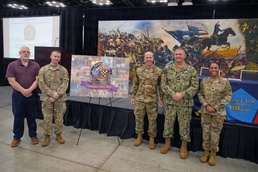
U.S. Military Entrance Processing Command (USMEPCOM) leaders shared how partnerships between Military Entrance Processing Stations (MEPS) and the National Guard are increasing applicant processing capacity and improving recruiting outcomes during a panel discussion at the National Guard Association of the United States General Conference, Aug. 29.
Brig. Gen. Olen Bridges, adjutant general of the Arkansas National Guard, joined Capt. Chris Carmichael, former USMEPCOM Western Sector commander, and Lt. Col. Elizabeth Cantrell, USMEPCOM 11th Battalion commander, to discuss how states can integrate National Guard personnel into MEPS operations to strengthen their recruiting pipelines.
The discussion focused on a partnership model that places qualified National Guard medical providers, technicians and administrative personnel in MEPS to help process applicants while giving Guard leaders greater insight into the accession process.
“Across the force, the National Guard and USMEPCOM share a common goal of getting qualified men and women into uniform,” said Carmichael. “The challenge has always been aligning resources with demand.”
Rather than relying solely on traditional Active-Duty Operational Support to fill gaps, USMEPCOM has worked directly with state National Guard leaders to identify qualified Guard personnel who can support MEPS operations after completing accession medicine training.
“What makes this model so effective is that it benefits both sides,” said Carmichael. “For USMEPCOM, it increases capacity and flexibility. For the National Guard, it provides a direct return on investment. States can apply resources where they see friction and immediately see the results in improved recruiting outcomes.”
One of the strongest examples came from Arkansas, where National Guard providers and medical technicians assigned to Little Rock MEPS helped produce a 62% increase in medical examinations and a 40% increase in enlistments over one year. In 11th Battalion alone, National Guard personnel are actively supporting operations in Kansas City, Little Rock, Oklahoma City and St, Louis.
“It has been very rewarding for us to partner with our USMEPCOM teammates,” said Bridges. “Not only did our shippers increase, but having our providers at the MEPS gave us greater understanding of their processes. We accomplish more as partners than we ever could when we were loosely connected.”
Carmichael encouraged National Guard leaders attending the conference to consider implementing similar partnerships in their own states.
“This is an initiative you can bring to your state,” said Carmichael. “Think of it as a lever you can pull without any orders or money transfer.”
Carmichael said the partnerships also improve communication between MEPS and National Guard recruiting organizations by giving Guard personnel firsthand knowledge of the applicant processing experience.
“When National Guard personnel work inside MEPS, they gain firsthand insight into the challenges applicants face and the importance of preparation,” said Carmichael. “That knowledge flows back to recruiting units, helping them reduce delays and better prepare future applicants. It removes the mystery of MEPS and replaces it with shared understanding.”
USMEPCOM hopes to expand the partnership model across additional states as the command continues to work with National Guard leaders to support future recruiting requirements. For those interested in joining a partnership with their local MEPS, leaders can reach out to the command team at each station by visiting [https://www.mepcom.army.mil/Sectors-Battalions-and-MEPS/](https://www.mepcom.army.mil/Sectors-Battalions-and-MEPS/).