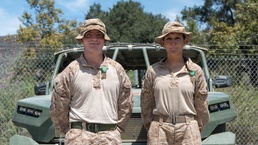
CAMPO, Calif. - A routine detection and monitoring mission along the southern border transitioned into a life-saving rescue on Aug. 7, 2026. Service members assigned to Joint Task Force-Southern Border (JTF-SB), in support of Operation Ardent Vanguard, treated and evacuated a suspected illegal alien suffering from severe heat illness near Campo.
Under temperatures exceeding 100 degrees, in the mountains of southern California, Lance Cpl. James Brooks and Pfc. Savi Garciamartinez, both infantrymen with 1st Battalion, 6th Marine Regiment, 2nd Marine Division, were manning a static observation post when U.S. Border Patrol radioed them regarding an individual in distress near their position.
Brooks and Garciamartinez left their post to locate the individual. After finding the man, Brooks immediately identified signs of a heat casualty and began cooling procedures. "I was grabbing ice from the cooler, running back and forth with ice packs and putting them in his groin, his armpits and on his neck just trying to cool him down," Brooks said.
Because Brooks did not speak Spanish, the language barrier presented an immediate obstacle. That is when Pfc. Garciamartinez used his ability to speak Spanish and translate what Brooks was doing. "[Pfc. Garciamartinez] was coordinating everything that the [suspected illegal alien] was saying so I could get him the best help as possible. Without him it would have been really hard to do what I did that day," Brooks said.
Garciamartinez translated the individual's symptoms as Brooks administered aid. "He was complaining of chest pains, telling us that he has been out there for three days, said he came all the way from Tijuana and that he had been out of water for so long. I immediately knew that he was heat casing or going to heat case," Brooks recalled.
At the same time, Brooks coordinated with the Sergeant of the Guard and U.S. Border Patrol to facilitate a medical evacuation at the landing zone. U.S. Navy Petty Officer Third Class Valeria Carmona, a hospital corpsman with 1st Battalion, 6th Marine Regiment, 2nd Marine Division, was returning to the command post with the Sergeant of the Guard when they received the radio call. "When I had heard that the patient was no longer sweating and that he was going unconscious, I immediately began in the back seat preparing IVs and my supplies so I was ready to go by the time we got there," Carmona said.
Upon arrival, Carmona evaluated the individual and spoke Spanish to reassure him. "I communicated with him the best I could of what I was going to do,” Carmona said. “It was more so trying to get him to have a level of comfort with me where he would allow me to perform any level of medicine."
The team secured the individual in the SKED litter and transported him up Tecate Peak to a pre-coordinated landing zone. During the climb, Carmona walked alongside the litter and held the IV bag above her head to maintain fluid flow as they traversed the steep terrain of Tecate Peak.
At the landing zone, the team met a Border Patrol Blackhawk helicopter. Due to the severity of the heat illness, Border Patrol agents requested that Carmona stay with the patient. Carmona remained with the patient, providing medical care until transferring the patient to civilian medical professionals.
For their actions that day, Brooks and Carmona received the Navy and Marine Corps Achievement Medal. 1st Lt. Jordan Corpuz, the 3rd Platoon Commander, Charlie Company, 1st Battalion, 6th Marine Regiment, attributed the rescue to the platoon's training culture. He noted that Carmona routinely integrated Tactical Combat Casualty Care (TCCC) training into the platoon's schedule prior to deployment.
"All the Marines of 3rd platoon have benefited from her knowledge and wisdom and the training that she has provided, and I think this is the ultimate pay off of what she’s prepared the Marines to do. It is a testament to their ability to train, to do their rehearsals and to treat every day like you never know what’s going to happen and prepare your best for it."
Corpuz further explained that the service members' actions are a true example of the Marine Corps being no better friend. “Lance Cpl. Brooks recognized that care was needed and that triage needed to be administered to this individual. The sanctity of life is important; I truly believe that and my Marines know that they acted on that and that speaks really about what this mission is about," Corpuz said. "It’s not only about protecting our southern border, it’s also providing aid for human beings."
Beyond the awards and operational success, the rescue left a lasting personal impact on both service members. For Brooks, who was the first to reach the individual and begin treatment, the rescue served as a stark reminder of the value of human life under critical conditions.
"The fact that I could get to him in the time that I could and ultimately save his life [by evacuating] him out of there really rendered well with me,” said Brooks. “It honestly held a special place in my heart for that person. Because I genuinely helped him out and if I wasn’t there or somebody else wasn’t there who knows what would have happened."
Carmona reflected on her role, explaining that a corpsman’s primary duty is to preserve human life and deliver medical aid to anyone in distress.
"It was having to see people regardless of their circumstances as human; they’re individuals,” said Carmona, “That’s our job, it doesn’t matter where they came from or who they are, it is our job to take care of people at the end of the day."
This successful medical evacuation highlights the constant readiness of JTF-SB service members to operate under austere conditions. The coordination between Brooks, Carmona, and U.S. Border Patrol reinforces the dual nature of their mission along the southern border, maintaining security while remaining ready to preserve human life at a moment's notice.
U.S. Northern Command is working side-by-side with the Department of Homeland Security and the U.S. Customs and Border Protection within narrowly defined authorities to provide unique military capabilities to protect the territorial integrity of the U.S. southern border.