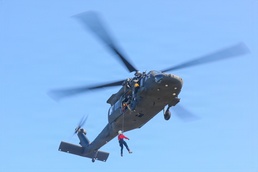
Jackson Springs, N.C. – When disaster strikes and roads disappear beneath floodwaters, bridges are washed away, or communities become isolated, rescuers may have to take to the sky. The North Carolina Helicopter Aquatic Rescue Team (NCHART) program teaches potential technicians how to operate in that environment and be prepared to act during incidents when conventional emergency response reaches its limits.
The NCHART program is a joint operation supported by the North Carolina National Guard’s 449th Combat Aviation Brigade, NC Emergency Management, NC Department of Public Safety, NC State Highway Patrol, and local first responders. Each partner brings a specialized capability to the mission, but the National Guard’s aviation assets enable NCHART to conduct and train for rescues in environments where traditional ground-based response may not be possible.
“The North Carolina National Guard plays a very critical role in our program. We couldn’t do it without them,” said Rodgers, Charlotte Rescue Officer.
More than 100 candidates began this month’s NCHART Indoctrination Course, and after undergoing a rigorous series of physical, technical, and aviation evaluations, only 24 candidates remained in the selection process. During this week’s training at the Samarcand Training Academy, several NCNG Soldiers conducted aviation operations by providing pilots and specialized aviation crews while operating HH-60M and UH-60 helicopters.
This partnership gives candidates an opportunity that cannot be replicated solely through classroom instruction; this program provides hands-on experience working with military aircraft and aviation crews. NCNG’s aviation support enabled candidates to practice hoist operations, aviation movement, and hand signals in an environment that replicated the demands of a real helicopter rescue.
“We bring a larger aircraft that can stay on missions longer and pick up more personnel versus the largest assets used, like the Bell and Lakota aircraft,” U.S. Army Sgt. Steven Rowe, NCHART Lead Hoist Instructor, said. “I value creating those heroes more now; I’m training up the new hoist operators who are going to go out and save the day.”
Having NCNG Aviation capabilities played an important role during Hurricane Helene in 2024, when catastrophic flooding, landslides, and damaged infrastructure isolated communities across western North Carolina. For people stranded in those areas, NCNG’s helicopters, NC State Highway Patrol's air capabilities, and NCHART technicians worked alongside pilots and aircrews to safely reach and extract them from locations inaccessible by ground.
For the 24 candidates still progressing through this month’s course, working alongside the 449th Combat Aviation Brigade provides more than a training exercise; it provides a firsthand look at what may be expected of them when a real emergency unfolds.
The aircraft provides the access, pilots and aircrews provide the aviation expertise, and the NCHART technicians provide the specialized rescue capability. Together, those pieces form a system designed to bring help to North Carolinians when the ground is no longer an option.
And when the next Hurricane Helene-like disaster occurs, the hours spent training at places like Samarcand Training Academy could become the preparation that makes a life-saving rescue possible. (U.S. Army story by Sgt. Brittany Burton)