FORT DETRICK, Md. – Instead of marking excess or expired medical supplies for disposal, U.S. Army Medical Logistics Command gives divested materiel a critical second life.
Through proactive coordination across the enterprise, excess Class VIII medical supplies are being redirected to support realistic training exercises for both joint forces and reserve components, maximizing taxpayer dollars while ensuring operational medical readiness.
Like any Army commodity, medical materiel is governed by specific handling and transportation policies. However, to guarantee patient safety, many items are bound by strict regulatory standards and expiration dates.
Additionally, the rapid pace of medical innovation and commercially available supply means equipment frequently becomes obsolete or not procurable as vendors change and newer, more advanced technology is adopted by the military health system.
The Army’s divestiture programs are designed to constantly cycle out excess, expired or obsolete materiel. For AMLC, this clears out vital warehouse space to make room for modernized, life-saving equipment and supply to continue supporting the warfighter.
While most of these divested items can no longer be used for real-world patient care, they remain perfectly viable for hands-on simulation and training, creating a unique opportunity for cost-saving partnerships.
“Efficient management of excess and expired materiel is a critical aspect of logistics,” said Maj. Daniel Miller, director of logistics for AMLC. “Our leadership has prioritized an aggressive divestiture strategy that turns potential inventory burden into readiness multipliers. By being proactive, we are providing joint force partners with critical training assets, while achieving significant cost avoidance across the enterprise.”
Two prime examples of these partnerships recently unfolded on different sides of the globe.
First, at Camp Carroll, South Korea, AMLC personnel stationed at Army Prepositioned Stocks-4, known as APS-4K, are staging medical supplies to be used as training aids for Naval Medical Forces Pacific, or NMFP, during an upcoming exercise.
Rather than purchasing new materiel for simulation, Navy logisticians reached out to AMLC to identify materiel already earmarked for divestiture from the APS-4K warehouse. The resulting transfer of 37 lines of materiel will amount to nearly $100,000 in direct cost avoidance for the joint exercise.
To execute the mission, NMFP will deploy a small, forward-sorting team to Camp Carroll to sort, pack and ship the requested items directly to the training location, allowing the APS-4K team to stay focused on its primary readiness mission.
Lt. Cmdr. Lauren Bailey, director of logistics support and policy for NMFP, said the partnership represents a major win for joint force resource management and training realism, establishing a repeatable blueprint for how the services can work together to manage Class VIII assets globally.
“The team there was so forthcoming and helpful,” Bailey said. “Having this physical, real-world Class VIII materiel, even if it’s expired, is a critical training asset that helps build the muscle memory required in high-stress environments. We’re not physically administering the materiel, but it’s about going through the motions.
“It reduces costs for the Navy and strengthens this bilateral relationship,” he added.
Simultaneously, personnel with AMLC’s Medical Materiel Readiness Program, or MMRP, based out of Sierra Army Depot, California, are actively working to push excess and expired materiel to support Army Reserve units.
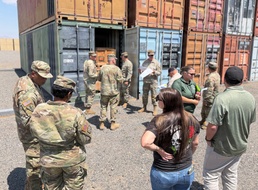
Forged in late 2025, the partnership with Army Reserve Medical Command is providing comprehensive support, making available not just excess medical supplies but also infrastructure needed to stand up a field hospital.
The effort has identified over 900 line items of Class VIII for direct patient care, valued at $1.4 million. Additionally, Sierra houses another $14.4 million in equipment marked for divestiture, including Class II clothing/individual equipment, Class VII major end items, such as shelters and power generators, and Class IX repair parts required to maintain that equipment.
“By using excess materiel, ARMEDCOM avoids tens of millions of dollars in new procurement costs,” said Master Sgt. Francisco Llanos, medical logistics noncommissioned officer in charge for ARMEDCOM. “Redistribution leverages already purchased, already in Army inventory assets. This is readiness delivered now, not years later.”
Sourcing this equipment allows Soldiers at Regional Training Site-Medical, or RTS-MED, platforms to train on the exact materiel they will see in a field environment, standardizing skill development and improving uniformity across the training sites.
“This means reduced downtime caused by missing or broken equipment, and more realistic training environments using actual deployment-configured materiel,” Llanos said. “Better equipment equals better training, which equals better medical readiness.”
At RTS-MED Fort McCoy in Wisconsin, logistics management specialist Bryon Kelly explained that acquiring this equipment, including everything from expendable supplies to durable shipping containers, directly resolves storage and capability gaps within the site’s massive 240-bed hospital center configurations.
“Standard procurement traditionally subjects us to prolonged acquisitions and funding cycles,” Kelly said. “By contrast, this strategic partnership capitalizes on previously acquired excess inventory, yielding significant cost savings across the Army medical enterprise while exponentially reducing transportation costs and lead times.”
The physical assets allow training coordinators at Fort McCoy and other RTS-MED platforms to build highly versatile, realistic training scenarios.
“By integrating these assets, Soldiers, leaders and units can train on the exact equipment they will operate in theater,” Kelly added. “This directly enhances individual proficiency and validates collective unit functionality, better posturing our forces to meet operational demands for both domestic and global missions.”
MMRP Director Richard Burlison said the ongoing divestiture effort also helps clear out aging inventory, while actively providing reserve components with what they need to fill training gaps.
“We want to see this equipment go somewhere it is truly needed,” Burlison said. “Until we reach a point where the units cannot take any more, we will continue pushing this materiel to support them.”
Beyond the logistical benefits of clearing warehouse space and avoiding disposal costs, Burlison emphasized the personal satisfaction his team gets from seeing their hard work yield results.
“We’ve been maintaining this equipment this whole time, keeping it ready,” he said. “There is a real sense of satisfaction for the team knowing that the materiel … is going somewhere to be put to good use, rather than just being scrapped.”
MMRP is a centralized U.S. Army Medicine contingency program designed to maintain, secure and rapidly deploy critical Class VIII assets for global combat and humanitarian operations. Managed by AMLC, the program ensures that complete, complex medical setups – including four complete hospital centers – are immediately available to support any U.S. military contingency operation.
Units looking to source training materiel via divestiture can work directly with AMLC to view available inventory and coordinate transfers, Burlison added.
“These partnerships in Korea and California are just examples of a much larger, command-wide effort to reduce excess materiel and enhance total force readiness,” Miller said. “We are committed to maximizing value of taxpayer dollars, while ensuring our warfighters have what they need to stay ready.”
As a major subordinate command of U.S. Army Communications-Electronics Command and alignedunder the Army Materiel Command enterprise, AMLC serves as the Army’s Class VIII medical materiel command.