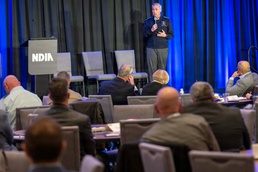
U.S. Space Command leaders convened at the National Defense Industrial Association Space Warfighter Forum, in Colorado Springs, Colorado, August 26-27, 2026.
Department of War leaders, industry experts, and allied military space professionals came together for the two-day forum, which included both a classified and unclassified day. Topics ranged from understanding threats to the space domain to eliminating integration gaps. Speakers and panelists included Mr. Richard Palmer, USSPACECOM Capability and Resource Integration deputy director, Lt. Gen. Rick Zellmann, USSPACECOM deputy commander, and Gen. Stephen Whiting, USSPACECOM commander.
During his opening remarks Palmer discussed USSPACECOM’s “Year of Integration,” the Apollo Insight tabletop exercise series, and reinforced the command’s focus on protecting the U.S and its allies and partners.
“The bottom line is that in an increasingly interdependent, interconnected world where space is a key part of everything we do, how do we bring that space capability to the defense of our homeland,” asked Palmer. “Our number one priority is to defend the homeland, to defend the American people and now, we’ve got to start thinking about threats in new ways and new opportunities that technology provides us.”
Zellmann’s remarks focused on the evolution of modern warfare, noting that adversaries are capitalizing on low-cost effects, rendering traditional assets much less effective – driving a need for strategic considerations within the domain.
“We have to get to a point that gives the adversary pause. We like having the offensive fire, but the defensive fire is also very important,” said Zellmann. “Space is big. We can’t be everywhere all the time. Having both onboard and offboard protections makes a lot of sense.”
During his closing remarks, Whiting quoted the preamble of the U.S. Constitution and its implied tasks to USSPACECOM; provide for the common defense and secure the blessings of liberty for ourselves and our posterity. He also focused on USSPACECOM’s three moral responsibilities.
“That’s why at U.S. Space Command we talk about three moral responsibilities. Number one, ensure that we deliver space effects to the joint force, our allies and our nation. Number two, we have to secure and defend the constellations we have today against the threats now arrayed against us. Third we have to help protect our nation, our joint force, and our allies from the space-enabled attack of our adversaries,” said Whiting.