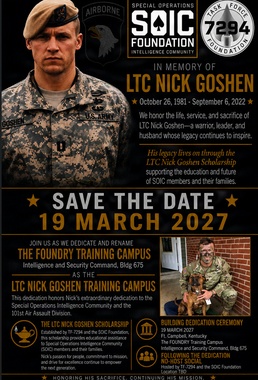
Fort Campbell will rename the Foundry Building, Building 6751, in honor of Lt. Col. Nicholas D. Goshen, a former 101st Airborne Division intelligence officer who died of natural causes while deployed with the division to Romania in 2022.
Goshen, who served as the division’s G2, or senior intelligence officer, was supporting the 101st Airborne Division’s deployment to Eastern Europe when he died Sept. 6, 2022. He was stationed at Mihail Kogalniceanu Air Base, Romania, as the division supported increased U.S. military commitments to NATO.
For Lt. Col. William Swafford, honoring Goshen with a building dedicated to the intelligence profession is a fitting tribute to an officer whose influence continues to shape Soldiers across the community.
“I thought it was important to honor the legacy of Nick Goshen,” Swafford said. “He was one who cared a lot about the profession that we had and cared a lot about the Soldiers that do the profession that we do.”
Swafford described Goshen as humble, athletic and deeply committed to mastering his craft.
“He was the standard-bearer inside of our profession,” Swafford said. “He was an excellent intelligence officer. He always took the opportunity to pursue the hardest jobs and get after the hardest assignments.”
Goshen began his Army career with the 101st Airborne Division in 2004 and later served in intelligence assignments across several of the Army’s most demanding formations. His career included service as a battalion intelligence officer with the 10th Mountain Division, assignments with the 75th Ranger Regiment and service as a brigade intelligence officer with the 173rd Airborne Brigade.
He later served on the Joint Staff at the Pentagon before returning to Fort Campbell to become Eagle 2.
For intelligence officers coming up behind him, Swafford said Goshen represented a model of what they hoped to become.
“For us who grew up pursuing jobs as intelligence officers, Nick was always kind of the guy you had aspirations to be like,” Swafford said. “He was this intelligence officer who we all wanted to be.”
Swafford and Goshen crossed paths repeatedly throughout their careers, including while both served on the Joint Staff. Swafford said Goshen often served as a professional example as he considered what assignments and challenges to pursue next.
During his time as Eagle 2, Goshen focused on developing intelligence professionals who were technically competent, physically fit and trusted by commanders.
“He felt passionate about being competent, capable, physically fit, but also being the guy or gal who knows the intelligence warfighting function through and through,” Swafford said.
Swafford said Goshen wanted Soldiers to receive meaningful training while also being empowered to develop confidence and credibility with commanders.
“He really wanted to make sure that he could provide ample opportunity for people to train on our warfighting function but also be given the latitude to build confidence within our commanders as an intelligence professional,” Swafford said.
The two frequently discussed their vision for the division’s intelligence enterprise, including during informal conversations over lunch.
“We had many meetings during lunch about how we were going to set the standards for intelligence in this division while he was going to be Eagle 2,” Swafford said.
Goshen deployed once to Iraq with the 101st Airborne Division and to Afghanistan during assignments with the 173rd Airborne Brigade, 75th Ranger Regiment and 10th Mountain Division.
His professional legacy, Swafford said, remains part of the division years after his death.
“To this day, we’re still all talking about what Nick did,” Swafford said.
Renaming the Foundry Building in Goshen’s honor will provide a permanent reminder of the standards he set and the intelligence professionals he inspired throughout his career.