BUFFALO, N.Y. — When U.S. Army Corps of Engineers, Buffalo District employee Susan Garand received a call at the end of May asking about her availability to deploy to Saipan, her first reaction wasn't an immediate yes. She had questions.
“Where is Saipan? What will I be doing? What language do they speak?” Garand recalled thinking.
But after a brief pause, another thought took over: When would she ever have another opportunity to travel to an island chain in the middle of the Pacific Ocean while supporting communities recovering from a disaster?
Thirty days later, Garand returned home with a greater appreciation for the U.S. Army Corps of Engineers' disaster response mission and the people it serves.
“It was one of the best decisions I could have made,” Garand said.
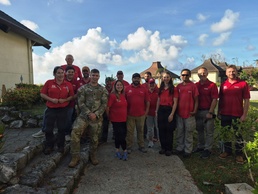
Garand deployed as a local government liaison, or LGL, supporting the federal response in the Commonwealth of the Northern Mariana Islands after Typhoon Sinlaku caused extensive damage across the islands, particularly Saipan and Tinian.
Her deployment placed her thousands of miles from Buffalo and offered a firsthand look at a part of the Corps of Engineers' mission that many employees may never experience.
Getting there was a mission of its own.
Garand's journey took three days. She first flew to Honolulu, where she stayed overnight before in-processing with the Corps of Engineers' Honolulu District. From there, she traveled to Guam, spent another night and boarded a final flight to Saipan the following day.
The long trip carried her across the International Date Line, putting her 14 hours ahead of her family and friends at home.
Saipan is the capital and largest island of the Commonwealth of the Northern Mariana Islands, a U.S. commonwealth in the western Pacific. Along with Saipan, the inhabited islands of Tinian and Rota were part of the area Garand supported during her deployment.
Beyond experiencing the islands as part of a modern disaster response, Garand also encountered reminders of their significant role in World War II. Saipan and Tinian were the sites of major battles during the war, and remnants of that history remain visible across the islands today. On Tinian, U.S. forces constructed the airfields used to launch the atomic bomb missions against Hiroshima and Nagasaki in 1945.
“Our presence in CNMI during World War II was integral to us beating Japan and ending the war,” Garand said. “There are tanks in the water off the coast of Saipan from the war, and there are multiple bunkers still in place on all three islands. There are even bunkers carved out of the cliffs where Japan tried to defend themselves during the war.”
For Garand, seeing those remnants added another dimension to an assignment that had already taken her somewhere she never expected her career with USACE would lead.
Local government liaisons are often among those helping establish communication and relationships among federal, territorial and local governments and disaster survivors early in a response. Garand, however, arrived in the middle of the mission and remained through its conclusion.
That timing gave her a different perspective.
Garand supported a temporary roofing mission designed to provide relief to residents whose homes were damaged by the storm. Unlike the blue temporary roofs commonly associated with U.S. Army Corps of Engineers disaster response, many homes on the islands use metal roofing. Crews installed temporary metal roofs to protect qualifying homes from the elements.
The work brought together civilian contractors and service members from the Army, Navy and Marine Corps. During her 30-day deployment, Garand traveled to Rota once and Tinian several times to assist quality assurance personnel with final home inspections. Reaching the neighboring islands sometimes meant boarding small aircraft carrying only a handful of passengers.
“It was a bit nerve-racking at times, but very exciting, too,” Garand said.
But it wasn't the flights, inspections or opportunity to travel across the Pacific that Garand remembers as the most rewarding part of the deployment.
It was answering the phone.
Garand eventually took responsibility for the temporary roofing team's complaint line, speaking directly with residents of Saipan, Tinian and Rota seeking information and assistance. Some conversations required her to deliver difficult news, including telling residents their homes did not qualify for the program. Yet Garand said she was struck by the gratitude she encountered, even during those conversations.
“The natives were so grateful for our presence and even thanked me profusely for being there even when I had to tell them that their home didn't qualify for our program,” Garand said.
That appreciation extended beyond the work site. Residents approached Corps of Engineers personnel while they were eating lunch or traveling around the islands simply to thank them for coming and helping.
“It is great to see a smile on a survivor's face even though their lives were just turned upside down,” she said.
Amid the long days and serious work of disaster response, Garand also found a simple way to document her experience. Each night of her deployment, she photographed the sunset.
The collection became a daily record of a place nearly 8,000 miles from Buffalo and of an experience that took her far beyond her normal role with the Buffalo District.
By the end of her 30 days, those photographs captured more than the scenery. Between sunsets, trips among the islands, remnants of World War II history and conversations with survivors, Garand experienced both the reach of the Corps of Engineers' mission and the impact its employees can have when they answer the call to deploy.
She returned to Buffalo with a new perspective on both disaster response and the wide range of the Corps of Engineers' mission.
Garand said she would encourage other USACE employees to consider deploying when opportunities arise, even when the destination or assignment initially feels unfamiliar.
“Each one is unique, and you may see parts of the country you wouldn't normally see,” Garand said. “You also can see a part of USACE that is not always talked about and a lot of employees don't even know exists, disaster response.”
For Garand, an unexpected phone call asking about her availability ultimately became a reminder of why she serves.
“One more reason that I can proudly say, ‘I work for the Army Corps of Engineers!’
The Buffalo District delivers world class engineering solutions to the Great Lakes Region, the Army and the Nation to ensure national security, environmental sustainability, water resource management, and emergency assistance during peace and war. Learn more at www.lrd.usace.army.mil/buffalo.