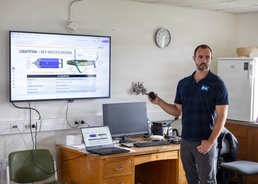
WHALE BAY, Iceland – Inside a quiet, mundane briefing room within a gated lot in Whale Bay, Iceland, the cutting-edge future of North Atlantic security is mapped out and projected on a television screen. At this moment, there are no distractions.
The only sounds are pens writing on paper, a clicking computer mouse and a fly in the corner that can’t figure out how to leave. An Icelandic Coast Guardsman sits in a chair, the members of the Center for Naval Analysis are seated on a couch and a U.S. Navy Sailor stands in the corner. Everyone is focused on the presentation about the machine that is just down the hill from this room. The machine that is ready to handle all types of temperature, weather and waters: the Lightfish Unmanned Surface Vessel (USV).
The Commander, Task Force 66 Lightfish academic training is a critical evolution as part of exercise Northern Viking 2026 (NV26), a Joint force and Allied live exercise (LIVEX) that aims to strengthen interoperability and forge readiness between the United States and the Greenland-Iceland-United Kingdom (GUIK) gap.
While allied ships and aircraft patrol the Icelandic coastline, the training in this classroom focused on operators learning to deploy and control independent, solar-equipped drones built to track threats in real-time.
Training wasn’t just an academic exercise for Lt. Cmdr. Michael Severin, assigned to CTF-66, it was a sea change.
“This particular training we’re giving is important,” said Severin. “We should always be trying to innovate, make things better and work more efficiently. In this training, we are moving in that direction of bringing innovative ideas and solutions to provide greater maritime domain awareness in and around Iceland.”
Although it’s important to learn the technology behind the Lightfish inside the classroom, the bilateral collaboration and hands-on experience between the U.S. and Icelandic counterparts is the true power behind NV26.
Severin emphasized that teaching the Icelandic Coast Guard to operate USVs is where ingenuity meets strategic reality.
“The U.S. is always looking to work with allies and partners, especially partners that know their geographical area better than anyone and I think this is why it’s important to join together with the Icelandic Coast Guard,” said Severin. “This is their water space, this is their area of expertise and it’s beneficial to learn from them. The U.S. is always looking to enable our allies and partners to work together.”
Collaboration with Allies highlights the importance of human expertise and shared experiences. Sharing knowledge on the Lightfish demonstrates the United States’ unwavering commitment to Iceland and the security and stability of the North Atlantic.
As the academic training wrapped up, notebooks closed, and pens unclicked, the impact of the lessons taught remain. Bridging the gap between American technological innovation and Icelandic geographic mastery, the CTF-66 Lightfish academic training proved that the future of maritime defense doesn’t just rely on smarter machines, but smarter partnerships.