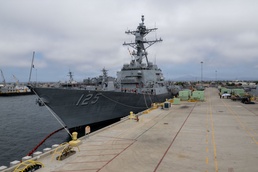
The U.S. Navy is undergoing its most significant technological transformation to the Arleigh Burke-class guided missile destroyer (DDG) by introducing the Flight III variant to the Surface Fleet. Flight III represents a revolutionary shift rather than a simple incremental upgrade, essentially a new type-model warship. With two Flight III destroyers delivered, and another 23 currently under contract or in construction at major U.S. shipyards, this capability is transforming how Navy crews operate and project power.
Guided-missile destroyers are the backbone of the U.S. Navy’s Surface Fleet. They are highly capable, multi-mission ships that conduct a variety of operations ranging from peacetime presence to national security and crisis response. As threats in contested environments grow increasingly complex, the Flight III is adapted for this fight with integrating technology such as the AN/SPY-6(V)1 Air and Missile Defense Radar (AMDR) and the Aegis Baseline 10 weapons system, ultimately making it the most advanced and lethal U.S. Navy warship today.
Advanced radar and combat system
The Aegis Baseline 10, an advanced combat system built to handle the immense data from the AMDR, the most powerful radar ever fielded on a U.S. Navy surface ship. The increased sensitivity of the radar allows the crew to detect, track and target more complex targets at a greater distance and in less time than the legacy destroyer. This technological leap also allows a Flight III destroyer to simultaneously conduct Air Defense and BMD operations without degradation in performance, effectively performing the work of two Flight IIA ships.
Updated power and cooling infrastructure
For decades, Flight IIA destroyers have relied on a traditional 450-volt electrical system. While highly reliable, this legacy electrical grid is near capacity, leaving little room to power modern, energy-intensive radar systems or future directed-energy weapons. The heightened sensitivity of the AMDR requires a greater demand for ship’s power. The 4160-volt power grid on these ships is designed to fill these needs and leave room for future capability.
The cooling systems on the Flight III have also been upgraded to include more capable air conditioning units and increased chilled water capacity to support the new loads required for AMDR and AEGIS.
Flight III’s also contain updated gas turbine generator sets, which produce 4 megawatts each and a modified steel hull to carry the weight of the new equipment and systems, displacing over 9,500 tons compared to a Flight IIA displacing approximately 9,300 tons.
USS Jack H. Lucas
The lead ship in the Flight III variant, USS Jack H. Lucas (DDG 125), commissioned in Tampa, Florida, Oct. 7, 2023. The warship is named in honor of Marine Corps Private First Class Jacklyn “Jack” Lucas, who at age 17 became the youngest Marine ever and youngest World War II serviceman to receive a Medal of Honor for his heroic actions at Iwo Jima on Feb. 20, 1945.
Jack H. Lucas will be in an air and missile defense commander (AMDC) role for an aircraft carrier strike group. The AMDC is responsible for defending the strike group against airborne and ballistic missile threats. Currently, USS Jack H. Lucas is undergoing her Initial Operational Test and Evaluation period validating the hull, mechanical and electrical and combat systems to ensure they can deliver their required capability. The ship will be on a rigorous, intensive underway schedule for the next 13 months. As the Navy’s only operational Flight III destroyer, the USS Jack H. Lucas showcased its advanced capabilities during Pacific Dragon 2026. Executed by Commander, U.S. 3rd Fleet around the Hawaiian Islands from Aug. 6-13, 2026, the biennial exercise brought together the U.S. Missile Defense Agency alongside allied and partner forces to improve joint ballistic missile defense and tactical data sharing.
“Jack H. Lucas represents a quantum leap in surface warfare lethality; and our success working with allied forces during Pacific Dragon 2026 proved that our combined integrated air and missile defense capabilities deliver unprecedented dominance in the Pacific," said Capt. Rob Niemeyer, commanding officer of Jack H. Lucas. “Yet, even with the most advanced radar and combat system in the world, technology is only a force multiplier. The real advantage will always be our Sailors—their grit, expertise and dedication are what transform our cutting-edge warship into an unmatched instrument of American sea power."
Future USS Ted Stevens
The future USS Ted Stevens (DDG 128) is closely approaching its commissioning date and will be the second Flight III in the fleet. The ship recently completed the Flight III Full Ship Shock Trials (FSST) to validate the shock hardness and ability to sustain operations in a simulated combat environment using live ordnance. FSSTs are complex evolutions conducted during a precise operating schedule in compliance with rigorous environmental and safety requirements.
"Being part of the first crew on Ted Stevens has been an honor. I think the Flight III's represent the future of Integrated Air and Missile Defense and an upgrade that strike groups need," said Capt. Mary Katey Hays, commanding officer of Ted Stevens. "If sailors are looking for an exciting challenge, or to make a difference, they should come on over to the Flight III."
Future USS Louis H. Wilson Jr.
The future USS Louis H. Wilson Jr. (DDG 126) is expected to be commissioned into the Surface Force. Yeoman 1st Class Kristha Hernandez, currently assigned to the ship, expressed her excitement about carrying on the legacy of excellence and leadership of the ship’s namesake, U.S. Marine Corps Gen. Louis H. Wilson Jr., a World War World II Medal of Honor recipient who went on to serve as the Commandant of the Marine Corps. “Serving on the next class of DDGs represents far more than the achievement of a long-standing career goal,” said Hernandez. “It is an opportunity to be part of the future of the U.S. Navy and contribute directly to its mission of maintaining maritime superiority.”
DDG 51 Flight III ships will ensure the Navy's surface combatants remain ready to project credible power at sea, ashore and abroad for decades to come.
Commander, Naval Surface Force, U.S. Pacific Fleet ensures fleet commanders are provided with personnel, material and training required to project credible naval power at sea, ashore, at home and abroad.
For more news from Commander, Naval Surface Force, U.S Pacific Fleet visit www.surfpac.navy.mil or follow on Facebook at www.facebook.com/surfacewarriors and on Instagram at www.instagram.com/surface_warriors.