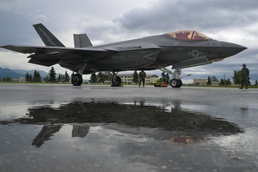
JOINT BASE ELMENDORF-RICHARDSON, Alaska – RED FLAG-Alaska’s third and final iteration of 2026 took place Aug. 14-18. RF-A training spans from individual skills to complex, large-scale joint engagements. The exercises can be adapted to integrate various forces into a realistic threat environment using the 120,000 square miles of airspace in the Joint Pacific Alaska Range Complex. RF-A is an annual Pacific Air Forces-sponsored exercise. By utilizing the JPARC, RF-A leverages the expansive area and diverse training environments of Alaska, with primary operations based out of Eielson Air Force Base and Joint Base Elmendorf-Richardson. RF-A 26-3 was a designated Special Technical Operation flag – meaning participants can practice synchronizing multi-domain capabilities across air, space and cyberspace to replicate capabilities of peer or near-peer adversaries to solve complex high-end problem sets. “We focus on integrating STO effects into the battlespace to provide realistic degradations that our forces can expect to see in a peer and near-peer conflict,” said U.S. Air Force Capt. Jason Bentley, 354th Operation Group Detachment 1 Red Flag 26-3 team lead. “For example, we leverage non-kinetic effects, which are military or strategic actions that achieve goals without using physical destruction or traditional explosive force that disrupt and complicate coordination for our forces.” Participating aircraft this year included U.S. Marine Corps F-35C Lightning II assigned to Marine Fighter Attack Squadron 251 from Marine Corps Air Station Cherry Point, North Carolina; E-3 Sentry Airborne Warning and Control Systems flown by the 961st Airborne Air Control Squadron from Kadena Air Base, Japan; and F-22 Raptors assigned to the 3rd Wing from JBER, Alaska. Since RF-A 26-3 is an STO exercise, it provided unique challenges to both planners and players. Joint and coalition and participants practiced how to coordinate efforts against complex air defense threats and efficiently integrate a wide spectrum of effects to defeat those same threats, said Bentley. “Working with the Air Force during this exercise has been a great opportunity to learn from each other and see how different teams approach the same challenges,” said U.S. Marine Corps 1st Lt. Phil English, F-35C Lightning II pilot assigned to the VMFA-251. “We’ve been able to talk through different exercise scenarios, share our experiences and learn what works well from one another.”
RF-A has a sustained history of allied and partner participation. Combined training exchanges tactics, techniques and procedures and directly improves interoperability. Homeland defense requires layered, integrated operations extending beyond U.S. borders, coordinated across combatant commands and with allied and partner forces. RF-A provides realistic air combat training to sustain that capability and support power projection.
“Executing an exercise of this scale can be a challenge, and it’s been humbling to see how we coordinate logistics and sustainment over such a vast area,” said Bentley. “Our forces overcome those challenges through rigorous mission planning, execution and successful debriefs from each sortie.”