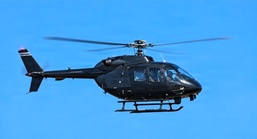
When an emergency occurs in difficult or inaccessible terrain, getting responders to those who need help can be one of the greatest challenges. During Patriot ’26, Kentucky National Guard aviators used the capabilities of the UH-72 Lakota to train for that challenge while working alongside Soldiers, Airmen and civilian emergency-response partners at Volk Field Combat Readiness Training Center and Fort McCoy, Wis., from Aug. 24–29.
Patriot ’26 brought together approximately 1,000 Airmen and Soldiers from National Guard units representing 35 states, along with federal, state and local agencies, for realistic domestic-response scenarios designed to improve readiness and interagency coordination during large-scale emergencies, organizers said.
The Kentucky National Guard aviation participation included aviators from the 751st Troop Command, 63rd Theater Aviation Brigade, with Soldiers from the 1st Battalion, 376th Aviation Regiment operating UH-72 Lakotas during the exercise.
Kentucky National Guard imagery documented the aircraft preparing for and conducting simulated missions from Volk Field. One scenario involved the Lakota crew preparing for a simulated mission to rescue victims stranded on top of a mountain. The scenario required aviators to use the aircraft's capabilities to locate and assist people in an environment where conventional ground access could be difficult or impossible.
The training demonstrated one of the Lakota’s primary strengths — its ability to provide a flexible aviation platform for missions such as search and rescue, surveillance, disaster response and medical evacuation.
The Army describes the UH-72 Lakota as a twin-engine light utility helicopter designed to perform a variety of missions, including search and rescue and medical evacuation. The aircraft can also support homeland-security and disaster-response missions, making it particularly suited for the type of domestic operations practiced during Patriot ’26.
During the exercise, Kentucky aviators also conducted simulated surveillance missions. Kentucky National Guard personnel documented a UH-72 taking off from Volk Field for a surveillance mission, while crew chief Sgt. 1st Class Shawn Firkins, assigned to Charlie Company, 1st Battalion, 376th Aviation Regiment, conducted preflight checks before another simulated mission.
The Lakota’s onboard camera capabilities also received attention during the exercise. Capt. Patrick Carlisle, commander of the 376th Aviation Regiment, discussed the aircraft’s camera capabilities with Lt. Col. Joseph Snoke, commander of the 751st Troop Command, and Command Sgt. Maj. Kenneth Varble.
Those capabilities can be particularly valuable during emergency operations, where aerial crews may need to locate people, survey an area, identify hazards or provide information to ground personnel before responders enter an affected area, exercise planners said.
Training beyond the flight line
The Kentucky aviation training was one component of a much larger Patriot ’26 training environment that extended across both Volk Field and Fort McCoy.
At Fort McCoy, participants used training areas and facilities across South Post, including Training Area Rice, Training Area Harrison, the Combined Arms Collective Training Facility, Young Air Assault Strip and Badger Drop Zone.
Fort McCoy also hosted medical-evacuation hoist training during the exercise. Soldiers with the Wisconsin Army National Guard's 1st Battalion, 147th Aviation Regiment used the Combined Arms Collective Training Facility to practice locating, hoisting and evacuating simulated casualties from areas where terrain or other conditions could prevent an aircraft from landing. The combination of aviation operations and ground-based emergency-response training gave Patriot participants opportunities to practice how different capabilities come together during a disaster.
A Lakota crew operating overhead may identify a person in distress or provide information about an affected area, facts show. Ground personnel may then have to reach that location, establish a safe landing or extraction area, treat casualties and coordinate evacuation. Other military and civilian organizations may simultaneously be dealing with damaged infrastructure, crowds, communications challenges or additional casualties.
That type of complexity is intentional. Planners said Patriot ’26 is designed to place participants in high-stress scenarios where conditions change and organizations must work together rather than operate independently. The exercise includes scenarios involving civil unrest, damaged structures, mass casualties, search and rescue and other emergency-response challenges.
A longstanding Fort McCoy-Volk Field partnership
The use of Fort McCoy in Patriot ’26 also continues a longstanding relationship between the installation and Volk Field.
Previous Patriot exercises have repeatedly used Fort McCoy's unique training capabilities to expand scenarios conducted primarily from Volk Field.
During Patriot North 2017, for example, more than 900 civilians, volunteers, Soldiers and Airmen participated in the exercise, which was operated mainly from Volk Field. Fort McCoy's Young Air Assault Strip and other training areas were used for the exercise, including aviation-related operations.
For Kentucky’s Lakota crews, Patriot ’26 provided an opportunity to practice aviation missions in support of a simulated emergency. For the larger exercise, their participation added an aerial capability that could be integrated with ground rescue, medical and incident-command operations.
And for Fort McCoy and Volk Field, the exercise demonstrated the value of having complementary military training installations operating together. When disaster strikes, responders may have to reach people in remote areas, operate around damaged infrastructure, locate casualties, move patients and provide commanders with information from the air — often simultaneously.
Patriot ’26 also possibly gave the Kentucky National Guard and its exercise partners an opportunity to practice those challenges before they become real-world missions. For the Lakota crews, that meant taking the capabilities of a light utility helicopter into a realistic emergency-response environment.
For Fort McCoy, it meant once again demonstrating that its training areas, aviation facilities and specialized facilities can help turn a large-scale exercise into a realistic, joint training experience.
Fort McCoy’s motto beginning in 2026 is “Training the Total Force and Shaping the Future since 1909.” The installation’s mission: “Fort McCoy strengthens Total Force Readiness by serving as a training center, Mobilization Force Generation Installation, and Strategic Support Area enabling warfighter lethality to deploy, fight, and win our nation’s wars.”
And Fort McCoy’s vision is, “To be the premier training center supporting the most capable, combat-ready, and lethal armed forces.”
Located in the heart of the upper Midwest, Fort McCoy is the only U.S. Army installation in Wisconsin. The installation has provided support and facilities for the field and classroom training of more than 100,000 military personnel from all services nearly every year since 1984.
Learn more about Fort McCoy online at https://home.army.mil/mccoy, on Facebook by searching “ftmccoy,” on Flickr at https://www.flickr.com/photos/fortmccoywi, and on DVIDS at https://www.dvidshub.net/unit/FMPAO. Also try downloading the My Army Post app to your smartphone and set “Fort McCoy” or another installation as your preferred base.
Fort McCoy is also part of Army’s Installation Management Command where “We Are The Army’s Home.”