When a building collapses, the cause matters less in the first critical moments than the ability of responders to find people, reach them and get them out safely.
Natural disasters, structural failures and other large-scale emergencies can create rescue conditions that many firefighters and medics may rarely encounter at their home stations. From Aug. 24-28, 2026, during Patriot 26, National Guard Airmen and Soldiers trained alongside civilian emergency responders at Volk Field Combat Readiness Training Center and Fort McCoy, Wisconsin, to develop those specialized skills before they are needed in a real-world response.
For Chief Master Sgt. David Franklin, a fire chief with the 125th Fighter Wing, Florida Air National Guard, and a civilian battalion chief in St. Johns County, Florida, Patriot 26 offers something difficult to replicate at a home station: the chance to train in a complex disaster environment alongside other military and emergency response organizations.
Franklin said Patriot 26 brought together Airmen from the 115th Fighter Wing, 185th Air Refueling Wing and 125th Fighter Wing, along with CBRNE Enhanced Response Force Package, or CERFP, medical specialists and the Wisconsin Army National Guard CERFP search and extraction element, giving the units an opportunity to train together in a complex disaster-response environment.
That mixture reflects how large domestic emergencies are managed. A major incident can quickly exceed the capabilities of a single department or agency, requiring National Guard units, local responders, emergency management personnel and other organizations to integrate their capabilities.
The CERFP is designed for that type of mission. Its capabilities include command and control, search and extraction, mass-casualty decontamination and medical stabilization, all focused on saving lives and reducing human suffering during catastrophic incidents.
At Patriot 26, participants practiced those capabilities in an environment designed to replicate the complexity of a disaster area.
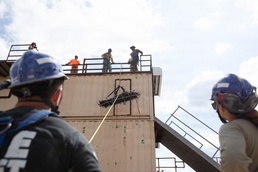
The Regional Emergency All-Climate Training (REACT) Center, operated by Wisconsin Emergency Management, includes training areas for structural collapse, rubble operations, rope rescue, breaching, shoring, lifting and moving. Its facilities allow military and civilian responders to work through scenarios that would be difficult to reproduce during routine home-station training.
Franklin said that scale is one of the biggest advantages.
“As firefighters, we do technical rescue training, but usually on a smaller scale,” Franklin said. “This gives us an opportunity to bring everything together and actually implement it in this environment.”
Search and extraction teams are specifically trained to perform rope rescue, structural collapse search and rescue, confined-space operations, lifting and loading, and other specialized rescue functions. During Patriot 26, Airmen practiced many of those same skills while working alongside experienced instructors and responders.
Senior Airman Victoria Routt, a firefighter assigned to the 125th Fighter Wing, Florida Air National Guard, said the training helped connect concepts she had previously only heard discussed by more experienced firefighters. Routt said the experience gave her a better understanding of rescue systems, terminology and techniques - knowledge she can carry back to her unit.
“We’ve done ropes and techniques before, but now we can increase the training since so many of us are here,” she said. “We can work on systems and pulleys and more advanced things.”
That transfer of knowledge is an important part of the exercise. Franklin said participants can return home not only with greater individual proficiency but also with lessons they can share with firefighters and responders who couldn't attend.
The exercise also gives participants something that cannot be built through technical instruction alone: experience working with unfamiliar organizations.
Wisconsin Task Force One leader Josh Uecker said disasters often require teams from different jurisdictions to work together with little notice. Patriot 26 gives those organizations a chance to establish relationships in a lower-stress environment before those relationships are tested during an actual emergency.
“When the disaster strikes, we’ve done it before,” Uecker said. “We’ve seen each other and we know kind of how to work together a little better.”
Senior Master Sgt. Thomas Donnan, a firefighter assigned to the 115th Fighter Wing, Wisconsin Air National Guard, said that integration directly supports the National Guard’s mission.
“This exercise is just an opportunity for us ... to focus on our skill set for our domestic operation capabilities,” Donnan said. “We’re exercising here, working on our rescue skills, working on our EMS skills, working on our firefighting skills, and then also how we integrate with civilian agencies.”
For responders, the goal is not simply to complete another training event. It is to make the unfamiliar familiar. A collapsed building, trapped casualty or large-scale disaster may present circumstances responders cannot fully predict. Patriot 26 gives them the opportunity to practice the technical skills, decision-making and interagency coordination required to respond when those circumstances become real.
The teams at Patriot 26 may not respond together again, but the skills, confidence and experience they build here can shape how they respond wherever they are called.