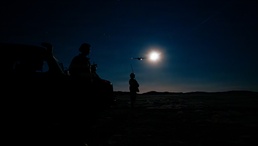
KEFLAVIK AIR BASE, ICELAND -- As the Arctic becomes more accessible and complex, a 75-year defense partnership between the United States and Iceland remains vital to North Atlantic stability. Meeting modern security challenges head-on at the “Gateway to the Arctic”, the 37th Airlift Squadron is playing a vital role in exercise Northern Viking 26, Aug. 22-Sept. 3, 2026.
Iceland sits at the crossroads of increasingly accessible maritime corridors with new transit routes and resources in the Arctic and High North setting the stage for increased activity and competition.
Northern Viking is a biennial military exercise hosted by Iceland and led by the U.S. Navy’s Sixth Fleet. Eleven NATO nations have joined this iteration, which includes training events taking place across Iceland.
The 37th AS, based out of Ramstein Air Base, Germany, arrived Aug. 21 to support NV26 and test their training in the north’s austere environment. They brought two U.S. Air Force C-130J Super Hercules aircraft to engage in specialized operations alongside NATO Allies.
U.S. Air Force Capt. Jill Ruane, 37th AS pilot, explained how critical operating in new environments is to sharpening unit readiness.
“Our participation in Northern Viking this year is super important because we’re working with other countries, other branches, other air platforms, and it’s really great training for us,” Ruane said.
The goal of Northern Viking 26 is to bring together U.S., Icelandic and NATO Allied activities in the Arctic into one overarching operational approach to the region to maintain a stable and prosperous Arctic region. Exercise missions hone partner nations’ ability to seamlessly operate together.
The nine-day exercise includes a wide variety of missions, testing force readiness for everything from rapid power projection to humanitarian aid. The objective for the 37th AS is to train in extreme conditions that pose unique challenges, testing crew readiness as well as the limits of the C-130J aircraft.
“This airplane is very versatile; it can do a lot so it’s really fun when we get to go out and actually put those types of things to practice,” said U.S. Air Force Senior Airman Lydia Knight, 37th AS loadmaster. “Especially here in the higher regions where it’s colder, we have procedures that we get to do, so it’s really fun to actually implement those. That way if circumstances arise where we have to do them, we know we have the skills and the wherewithal to execute.” U.S. Air Force Staff Sgt. Tessa Townsend, 37th AS loadmaster, described the various missions they were called on to perform during Northern Viking such as cargo drop, aeromedical evacuation, search and rescue, and formation flights.
The 37th AS uses the slick variant of the C-130J, meaning it is highly adaptable. “We’re not modified for any specific mission set, so we can configure to a lot of other things,” Townsend said. “We move people, cargo, pretty much anything, that needs to be tactically moved. We’re your guys.”
The crew are trained experts on their diverse mission sets, but training in the High North opens the door to an even broader array of conditions. Ruane spoke about the tactical flying she looked forward to throughout the exercise, to include her favorite low-altitude flying permitted by the exercise’s Icelandic hosts.
“We had the opportunity to practice at landing zones which are different than your typical airport,” Ruane said, “We landed on a beach for example and a grass field. This airplane can really do it all.”
This ability to operate independent of infrastructure matters for combat and personnel recovery missions alike. Training on unimproved surfaces expands operational access and reduces dependence on permanent runways, increasing the resilience and mobility of Allied airlift forces and giving commanders additional options to disperse, position and sustain forces.
“We’re working with a special platform of airdrop where we can guide it exactly where we want it to go. That really gives us versatility in being able to resupply people in various situations,” Knight said. “If anything happens with this inclement weather, someone’s stuck somewhere they need food or water, we’re able to get that directly to them. Especially in places like Iceland where weather can be a challenge for a lot of different aircraft.”
NV26 is not only vital to training for the conditions normally found in the High North, but to building cohesion betweenU.S. and the 11 participating NATO Allies. Ruane spoke about the 37th AS having the opportunity to interact with Allies at Ramstein Air Base where they’re located, but noted how the exercise had brought that collaboration to another level.
“We’re getting to stretch our cultural competency muscles that allow us to interact with different people from all over the world who have different ways of doing things,” Ruane said. “It’s really important to understand that every person is different, every country is different, but we still have to be able to work as a team to be able to provide security in the High North region and all over the globe.”