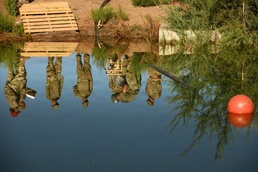
MARCH AIR RESERVE BASE, Calif. — Forty-four Airmen from the 146th Civil Engineer Squadron traveled to the 163d Regional Training Site for a five-day bivouac exercise designed to move their technical training from the classroom into a realistic field environment.
A bivouac is a field training exercise in which Airmen simulate living and working in forward operating conditions, often establishing temporary facilities and operating with limited infrastructure and resources. The training tests their ability to apply technical skills in austere environments while preparing for the challenges of deployed operations.
The 163d RTS serves as a centralized training location for Civil Engineer Airmen across the Total Force, providing specialized equipment, instructor expertise, and a field environment many units do not have at their home stations. RTS instructors train more than 1,000 Airmen annually in Rapid Damage Repair and other Civil Engineer specialty courses, building the skills and confidence needed to operate in demanding environments.
“We have a lot of new Airmen in our squadron, so we can go through things on a discussion level, but they can’t get their hands-on portion until we come here,” said Senior Master Sgt. Marc Trujillo, a 146th Civil Engineer Squadron superintendent.
During the exercise, Airmen trained on forklifts, water purification systems, heavy equipment, aircraft arresting systems, power production and other equipment and systems used across Civil Engineer career fields.
“Whatever the team needs to focus on, I can adjust my training. This group is newly out of technical school and junior Airmen, so my focus is getting them trained on the basics,” said Tech. Sgt. Rafael Jaime, a 163d Regional Training Site instructor for heating, ventilation and air conditioning.
The training also emphasized troubleshooting and restoring essential services in demanding conditions, requiring Airmen to draw on their technical knowledge and adapt as problems arise.
“We don’t have a technical order like other career fields, so I have to teach and mentor them how to troubleshoot on the spot to restore these services,” Jaime said. “You have people doing shift work and sleeping during the day a lot of times, and these HVAC units will go down when it’s over 100 degrees. We have to troubleshoot and get it working quickly.”
The field environment at the RTS added another layer to the training, exposing Airmen to conditions more representative of what they may encounter during an exercise or deployment.
“We’re moving people from the theoretical to practical, and the climate here also adds to the training,” Trujillo said. “We’re practicing with our combat gear on too, and simulating the stressors we may face elsewhere to build that muscle memory for a warrior mindset and to execute our mission at the top of our game.”
Staff Sgt. Joseph Navarro, 146th Civil Engineer Squadron HVAC team lead, said the training environment allowed his team to focus on troubleshooting skills that are difficult to replicate in a classroom.
“I like seeing my guys get the hands-on training with equipment we don’t have at home station,” Navarro said. “It’s great here because there are no distractions and we can get straight to work and focus on training.”
At the 163d Regional Training Site, the 146th Civil Engineer Squadron is turning technical knowledge into hands-on capability, building the agile combat support needed to project decisive airpower. Through realistic training, Airmen strengthen their confidence, readiness and warrior mindset, preparing them to execute the mission with excellence wherever they are called.