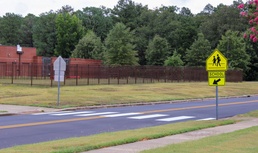
FORT BRAGG, N.C. — As students return to classrooms across Fort Bragg and surrounding communities, installation officials are reminding drivers and families that a successful school year begins before students ever reach the classroom.
According to the Fort Bragg Directorate of Emergency Services, one of the most important reminders for motorists is simple: slow down.
“Slow down in and around school zones,” Dean DeMark, deputy director of Fort Bragg DES, said. DES has a zero-tolerance policy for speeding in school zones. Driving 15 miles per hour over the posted speed limit will result in the suspension of installation driving privileges.
As school buses travel through installation roads and neighborhoods, motorists should be prepared to stop when buses activate their flashing lights and extended stop signs, regardless of their direction of travel. During morning and afternoon commutes, DeMark encourages drivers to remain alert for children around crosswalks, yield to all pedestrians and avoid using housing neighborhoods as shortcuts to bypass school or installation traffic.
Parents and guardians also play an important role in keeping children safe before and after the school day. Parents are encouraged to talk with their children about traffic rules and safe practices while walking or biking to school. Reflective clothing or gear can also help make students more visible to motorists during darker morning hours.
Distracted driving is another preventable safety concern. DeMark advises motorists to put down their phones, pay attention to their surroundings and slow down when approaching emergency vehicles stopped near roadways. Drivers encountering flashing red traffic lights should treat them as a stop sign, whether at a two-lane or four-way intersection.
While DES focuses on keeping our students safe, Fort Bragg School Support Services helps military families navigate the educational side of the school year.
“Our priority is to reach and communicate with our families as they make big decisions about education,” Gerhard Guevarra, Fort Bragg school liaison officer with Child and Youth Services, said.
School Liaison Officers assist families with educational questions from pre-kindergarten through 12th grade, including public schools, charter schools, homeschooling and post-secondary support.
For military families preparing for a Permanent Change of Station, Guevarra recommends contacting School Liaison Officers at both their current and gaining installations as early as possible.
“By connecting with their School Liaison Officer, they can receive the most accurate educational information about schools at their duty station,” Guevarra said. “Often, information online and word of mouth can be inaccurate or misleading. The earlier you speak to School Liaison Officers, the better they can assist you.”
Guevarra also encourages families to enroll their children as early as possible, particularly high school students. Guidance counselors enroll students in classes throughout the summer, so waiting can mean some desired classes have already reached capacity.
Military-connected students have additional resources available to help make transitions between duty stations easier. North Carolina law allows military families PCSing to Fort Bragg to begin enrolling their children in public schools remotely before establishing residency.
Families with teenagers can also use the Youth Sponsorship Program, which connects incoming teens with a youth sponsor before the move. Sponsors can help students learn about academics, activities and the community while providing a built-in peer connection at their new installation.
“What was standard in one duty station may not be the standard at another duty station,” Guevarra said. “It’s important to always connect with the Installation School Liaison Officer as early as possible.”
Families here have educational options available through the Fort Bragg High School Election Process. The program gives eligible active-duty military families living on Fort Bragg additional flexibility when selecting a Cumberland County high school if they choose not to attend E.E. Smith High School, the zoned high school for the installation. Families using this election process are responsible for transportation to and from the selected school.
School Support Services also assists Fort Bragg’s military-connected homeschool community with North Carolina homeschool requirements, local resources, PCS transitions and educational opportunities. This creates a partnership with a local homeschool group to provide designated space at the School Age Center for homeschool activities, programming and social opportunities.
As students settle into this school year, installation officials are asking everyone on Fort Bragg to play a role. Whether this be simply slowing down behind the wheel, helping children understand traffic safety or reaching out for assistance when navigating a new school system, everyone can make just as much of an impact this school year.