TYNDALL AIR FORCE BASE, Fla. — From thousands of feet in the air, details begin to melt away.
A seam in a metal panel. The precise contour of an edge. The difference between a replica meticulously recreated and one built for a fraction of the cost.
To a pilot’s eyes—or the sensors aboard their aircraft—what matters is whether the target looks real enough to fight.
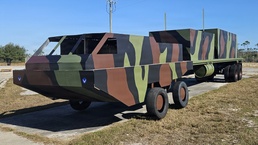
That distinction is helping expand testing over Florida’s Gulf Range, where engineers from the 53rd Test Support Squadron at Tyndall Air Force Base, Florida, have developed low-cost simulated targets designed to give aircrews something more representative than a set of coordinates on a screen.
“Tyndall AFB’s primary purpose has been air-to-air missile testing over the Gulf, and recently we’ve begun expanding the ground portion of the test range to facilitate more air-to-ground weapons testing,” said 1st Lt. Jared Angeles, 53rd Test Support Squadron special devices engineer and the project’s engineering lead. “Simulated targets allow pilots to have something real to lock onto and practice on as opposed to just known coordinates.”
For test teams, putting something on the ground is only the beginning.
The target has to look right. Sometimes, it has to act right, too.
Simulated targets generally fall into two categories: high fidelity and low fidelity. High-fidelity targets replicate both the physical appearance and electronic signature of the threat they represent. Low-fidelity targets recreate the physical characteristics necessary for pilots and aircraft sensors to recognize them without independently reproducing that electronic signature.
Both have their place.
“Each type is important to training pilots on what to look for visually and understanding how a target will appear on their aircraft’s sensors,” Angeles said.
Realism, however, can come at a price.
A high-fidelity representation can provide a more complete recreation of a threat, but not every test requires one. If evaluators only need a target to meet certain dimensions, reflectivity or visual characteristics, reproducing capabilities irrelevant to the test can add cost without adding useful data.
So engineers worked backward from the requirement.
“The most important factor to consider is the specific requirements of the customer,” said Darin Williams, 53rd TSS modelmaker leader and fabrication lead for the project. “Not every customer needs a perfect replica to collect the data they may need.”
The resulting low-fidelity targets cost approximately $4,700 each to fabricate.
Comparable targets previously cost roughly $25,000—a roughly 80 percent reduction in cost.
Achieving those savings, though, meant understanding what could be simplified—and what couldn’t.
Materials had to withstand exposure to the elements while providing the reflectivity required by aircraft sensors. The structures had to be sturdy, relatively easy to fabricate and similar enough in size and detail to the assets they were built to represent.
The result isn’t necessarily an exact copy.
It doesn’t need to be.
“The targets we created were meant to be a low-cost solution that satisfied a need set by one customer, but it may not be a solution for all future test events,” said Staff Sgt. Jared Boswell, 53rd TSS aircraft structural maintenance craftsman. “The customer sets the rules for what they want to see on their sensors and weapons systems, and we provide a solution that meets those specific objectives.”
Those requirements can change considerably depending on what’s being tested.
For some events, physical appearance and reflectivity may provide everything evaluators need. When greater fidelity is required, existing signal emitters can be positioned on or near the low-cost targets to reproduce the electronic features of an operational threat more closely.
The same relatively inexpensive structure can then become part of a more complex threat presentation without requiring engineers to build every capability into the target itself.
For aircrews, that translates into a more representative problem to solve.
“Creating a threat-realistic environment provides more beneficial training to pilots and allows them to develop tactics, techniques and procedures that are specific to a certain type of threat that they’re likely to encounter in theater,” said Staff Sgt. Adrian Gonzalez, 53rd TSS metals technology craftsman.
That realism has become increasingly important as testing expands from the airspace over the Gulf to the ground range below it.
Before the new targets arrived, Gonzalez said, pilots had nothing realistic to visually acquire in that portion of the range.
Now, instead of flying toward a predetermined point on a map, aircrews can search for, identify and engage something designed to resemble the threat their aircraft and weapons may eventually face.
The difference might be little more than a collection of metal sitting inert on the ground.
But from the cockpit, it’s something to find, identify and fight.