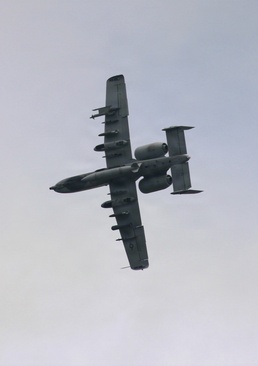
A-10C Thunderbolt II aircraft from the 303rd Fighter Squadron at Whiteman Air Force Base, Missouri, returned to Fort McCoy Aug. 17–21 for another round of specialized training that put the aircraft's distinctive capabilities to work over the installation.
According to Fort McCoy Directorate of Plans, Training, Mobilization and Security officials, the Air Force Reserve pilots conducted bombing training during the week, including low-level missions to the installation's impact area. The training also provided significant flight time for the pilots, giving them an opportunity to maintain and sharpen skills associated with operating the A-10 in a realistic training environment.
The return of the 303rd Fighter Squadron continues a longstanding relationship between the Air Force Reserve unit and Fort McCoy.
The 303rd Fighter Squadron is assigned to the 442nd Operations Group, 442nd Fighter Wing, Air Force Reserve Command, at Whiteman AFB. The squadron has a long history dating to World War II and was originally activated at what is now Whiteman Air Force Base in 1943. The squadron later transitioned to fighter operations and received the A-10 Thunderbolt II in the 1980s. It was redesignated the 303rd Fighter Squadron in 1992.
Today, the squadron flies the A-10C, an aircraft specifically designed for close air support and for operating in environments where accurate air-to-ground weapons employment is critical. That mission makes Fort McCoy a particularly valuable training location.
A training environment built for the A-10
The A-10 is different from many other fighter aircraft. Its design emphasizes low-altitude maneuverability, weapons-delivery accuracy, long loiter times, survivability and the ability to operate from austere locations.
Fort McCoy’s training environment allows A-10 crews to practice several of those capabilities in one location.
The installation’s large impact area provides a designated location for air-to-ground weapons training, while its extensive airspace and varied terrain allow pilots to conduct realistic flight profiles approaching and operating over training objectives.
During the August training, pilots flew low-level missions toward the impact area before conducting bombing runs. The combination gives pilots flight experience that goes beyond simply dropping practice munitions — it allows them to repeatedly work through the flight profiles, navigation, maneuvering and weapons-delivery skills associated with the A-10's close-air-support mission.
Fort McCoy has supported similar A-10 training in recent years. In September 2024, A-10s from the 303rd Fighter Squadron conducted several days of bombing training at the installation's impact area, including bombing runs with 1,000-pound munitions. The aircraft made repeated passes against targets on North Post while pilots worked on accurate and efficient weapons delivery.
A-10 training has also included operations at Fort McCoy's Young Air Assault Strip on South Post. In September 2023, A-10s used the strip for takeoff and landing training while flying routes over the installation. Similar A-10 training occurred at Fort McCoy in 2021 and 2022.
The Young Air Assault Strip adds another dimension to the installation’s ability to support the A-10.
The strip has been used by a variety of aircraft and military services for austere-airfield training. A-10s, C-130 Hercules aircraft, C-17 Globemaster IIIs and Army helicopters have all operated there over the years. The strip gives aircrews an opportunity to practice operations from a location that differs significantly from a conventional military airfield.
Keeping pilots proficient
For Air Force Reserve pilots, opportunities to obtain meaningful flight time are an important part of maintaining combat readiness.
The August training provided significant flying time while allowing the pilots to work on specific A-10 mission requirements.
That combination is one of Fort McCoy’s strengths.
Rather than being limited to a single training lane or a single type of facility, units can combine Fort McCoy's airspace, ranges, impact areas, terrain and airfield infrastructure to build training events around their mission requirements.
For the A-10, that means pilots can practice the aircraft’s ability to fly at low speeds and low altitudes, maneuver toward ground objectives, conduct weapons-delivery operations and repeatedly fly training profiles in a controlled environment.
The A-10C is especially suited to this type of training. The Air Force describes the aircraft as highly maneuverable at low airspeeds and altitude while maintaining a highly accurate weapons-delivery platform. The aircraft also can carry both precision-guided and unguided munitions and can operate from austere locations.
The aircraft’s famous 30 mm GAU-8/A Gatling gun is another part of the A-10’s unique combat capability, although the August training at Fort McCoy focused on bombing operations.
A Total Force training relationship
The recurring presence of the 303rd Fighter Squadron at Fort McCoy also illustrates the installation’s role as “training the Total Force.”
Fort McCoy routinely supports training for active-duty, Reserve and National Guard forces from across the military services. Its combination of ranges, airspace, terrain, airfields and training infrastructure allows units to conduct specialized training that may not be available at their home installations.
For the 303rd Fighter Squadron, that means Fort McCoy can provide a training environment where A-10 crews can concentrate on the aircraft's unique strengths and mission requirements. The relationship also demonstrates the value of joint and multi-service training infrastructure.
The A-10 was designed around a mission that requires close integration with ground forces. Training in an Army environment — over Army-managed training areas and against designated ground objectives — provides Air Force Reserve crews with an environment that more closely reflects the type of joint battlefield for which the aircraft was designed.
The 303rd’s return to Fort McCoy in August is another example of that capability. As the Air Force Reserve continues preparing its A-10 crews to remain ready for operational missions, Fort McCoy provides the space, infrastructure and professional support necessary to turn flight time into meaningful training.
For an aircraft built to get low, stay close and deliver precise effects against ground targets, McCoy offers a training environment well suited to the mission.
Fort McCoy’s motto beginning in 2026 is “Training the Total Force and Shaping the Future since 1909.” The installation’s mission: “Fort McCoy strengthens Total Force Readiness by serving as a training center, Mobilization Force Generation Installation, and Strategic Support Area enabling warfighter lethality to deploy, fight, and win our nation’s wars.”
And Fort McCoy’s vision is, “To be the premier training center supporting the most capable, combat-ready, and lethal armed forces.”
Located in the heart of the upper Midwest, Fort McCoy is the only U.S. Army installation in Wisconsin. The installation has provided support and facilities for the field and classroom training of more than 100,000 military personnel from all services nearly every year since 1984.
Learn more about Fort McCoy online at https://home.army.mil/mccoy, on Facebook by searching “ftmccoy,” on Flickr at https://www.flickr.com/photos/fortmccoywi, and on DVIDS at https://www.dvidshub.net/unit/FMPAO. Also try downloading the My Army Post app to your smartphone and set “Fort McCoy” or another installation as your preferred base.
Fort McCoy is also part of Army’s Installation Management Command where “We Are The Army’s Home.”