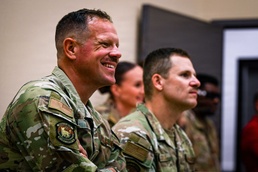
Inside the Airman Leadership School at Luke Air Force Base, four handcrafted model aircraft recently gave students more than a lesson in Air Force history. They provided an opportunity to learn directly from some of the veterans who flew and maintained the aircraft represented by the models.
Members of the Luke AFB scale model club, some of whom are military retirees, presented the school with models of an F-86 Sabre, F-4 Phantom II, F-15D Eagle and F-16D Fighting Falcon. Each aircraft played a significant role in Luke AFB’s history and training mission.
The presentation also brought together Airmen preparing for leadership roles with veterans who experienced earlier generations of Air Force operations firsthand.
“These aircraft aren't just a piece of metal or a piece of plastic,” said Staff Sgt. Darius Futrell, 56th Force Support Squadron Airman Leadership School instructor. “These retirees poured their heart and soul into this craft, taking 50 to 100 hours to create something beautiful so that Airmen can see a piece of history showcased in our rooms.”
The models served as a starting point for conversations about aircraft maintenance, training and the standards required to generate combat-ready forces.
For the students, the discussions also offered a connection between the Air Force’s history and its current mission as the service prepares for future conflicts.
“They set the foundation for us so that we can run,” said Senior Airman Gavin Eans, 362nd Recruiting Squadron enlisted recruiter. “Without their foundation, we'd be stuck crawling.”
Retired U.S. Air Force Capt. Don Stewart, a former F-4 Phantom II weapons systems officer and member of the model club, said understanding the lessons of previous generations is essential to preparing Airmen for the future.
“You really can't build for the future if you don't know the past,” said Stewart. “If you make a mistake in the past, and the new generation doesn't know about it, they're probably going to make it again.”
Stewart also shared an experience from his time stationed in Okinawa, Japan, where his F-4 Phantom II caught fire on the flightline.
“As we were about to taxi, I looked to the right wing, and there were flames coming up the front out the side and out the back,” Stewart said. “I had nine seconds to get out of the cockpit. I think I did it in three.”
The experience reinforced a lesson Stewart wanted the students to carry with them that operational readiness, training and maintaining uncompromising standards can save lives.
“I was standing on the ground before I even knew what happened, and that was because of the training I’d had to do over and over and over,” Stewart said. “When it comes to our job, if you take a shortcut, there's a problem with the airplane, and that could end someone’s life. Just do what you're supposed to do and don't slack off.”
For the ALS instructors, having veterans share those lessons directly with students added context that cannot always be provided through classroom instruction.
“I can sit here all I want and instruct these Airmen,” Futrell said. “But until they experience it or get to hear that from those who've done it before them, it’s harder for them [Airmen] to understand.”
Eans further supported this by saying that hearing the veterans' experiences helped connect the history of the aircraft with the Air Force’s mission. “Learning about the overall mission and then hearing their stories in person, we got to see the connection: same mission, different people.”
The models will remain in the ALS classrooms named for their respective aircraft, providing students with a daily reminder of Luke AFB’s history and the excellence expected of Airmen.
“The standard you set today,” Futrell said, “is the legacy you leave tomorrow.”