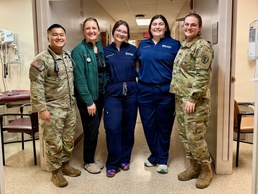
FORT POLK, La. — Bayne-Jones Army Community Hospital may be a small, rural military hospital, but its mission extends beyond caring for today’s patients. Throughout the year, its clinics and departments also serve as classrooms where military and civilian students gain hands-on experience preparing to become tomorrow’s healthcare professionals.
Approximately 30 military and civilian students complete clinical rotations at BJACH annually through academic partnerships and Army medical training programs.
For second-year physician assistant students Miya Browning and Tayler Hooper, that classroom this month is BJACH’s Pediatric Clinic.
Browning, a native of the city of Central near Baton Rouge, had little previous exposure to the military and wasn’t sure what to expect when she learned her required pediatric rotation would take place at an Army hospital.
Her apprehension didn’t last long.
“From my first day, I was welcomed by everyone and immediately felt a part of the team,” Browning said. “All the doctors, nurses and other staff would answer any questions we had.”
Browning and Hooper, Franciscan Missionaries of Our Lady University students completed their required pediatric clinical rotation at BJACH Aug. 3-27 under the supervision of Maj. Benjamin H. Tan, chief of the Department of Pediatrics, and Army pediatricians Capt. Hailey Buller and Capt. Kiara Schein. Family medicine providers also contribute to their clinical education.
BJACH’s partnership with FranU dates to 2019 and is one of several academic and military training relationships supporting the hospital’s clinical education mission.
“Medicine is built on teaching future generations to make evidence-based decisions while balancing patient and family goals,” Tan said. “In the military, it is the bedrock to make sure students fresh out of training are equipped to lead and care for patients.”
Learning in a rural military hospital
As a rural community hospital, BJACH operates with more limited access to equipment and specialty care than a large medical center. Tan said providers sometimes begin managing complex conditions while patients await or establish care with specialists, giving students a different perspective on clinical decision-making and patient management.
“My goal of the rotation is to provide students with opportunities to be exposed to a variety of pediatric patients in order to develop clinical skills in a safe and practical environment while maintaining quality care,” Tan said.
Hooper said BJACH also offers exposure to different levels of pediatric care because the clinic is located within a hospital that includes labor and delivery and inpatient services.
“This combination of outpatient, inpatient and emergency medicine within pediatrics is not commonplace and has allowed for a comprehensive education,” Hooper said.
For Browning, exposure to pediatric rashes and infectious diseases helped translate classroom learning into clinical experience.
“In class, we discuss them and briefly look at images,” Browning said. “I’m a very visual learner, so being able to see these in person has helped solidify my ability to identify them on future exams and in clinical practice.”
Both students said the rotation helped them become more comfortable interacting with children. Browning learned to adjust her communication for different ages and personalities, while Hooper learned the importance of flexibility during pediatric examinations.
“Sometimes kids are more comfortable sitting on a parent’s lap, standing up or lying down,” Hooper said. “It is important to allow them to do what is comfortable so you can obtain the best physical exam you can.”
For younger or apprehensive children, Hooper said she sometimes demonstrates an examination technique on a parent first.
“Showing them what I am going to do on mom, or dad helps build their confidence and calm them,” she said.
Mentoring future providers
The students’ education extends beyond patient encounters.
Browning said the pediatric team challenges them to conduct patient histories, perform physical examinations, develop “Chalk Talks” and review material for their end-of-rotation examination between patients.
“Their willingness to teach and educate my classmate and me has been the most impactful thing during this rotation,” Browning said. “It has challenged me to work on my patient encounters and strive to become an even better provider.”
Hooper said Tan, Buller and Schein provide hands-on training, current clinical literature and discussions about caring for children at different developmental stages.
“They have pushed us to think critically and outside of the box so that our patients will receive the best care possible,” Hooper said.
Tan said teaching students benefits the preceptors as well.
“Teaching students requires staying on top of your own education,” he said. “Students that rotate with us bring a new energy and spark.”
He also wants students to develop curiosity and an ability to connect with pediatric patients.
“I hope students will learn to have fun with their clinic time,” Tan said. “Learn to be curious and ask questions to get to the root cause of patient and parental concerns.”
Building the partnerships behind the rotations
Hospital Education and Staff Development coordinates with universities, clinical departments and support staff to make student rotations possible.
Kathy Adams, BJACH healthcare training administrator, said HESD works with academic partners to coordinate placements, ensure required agreements and documentation are current, and prepare students for their clinical experience. For students unfamiliar with military installations, that support can include assistance with lodging, installation access and hospital orientation. Adams also checks in with students throughout their rotation.
Current academic partners include Northwestern State University’s radiography program, McNeese State University’s nursing and nurse practitioner programs and Louisiana State University’s social work programs, among others. Army advanced individual training students also complete clinical experiences at BJACH in areas including laboratory services and physical therapy.
A different view of military medicine
The rotation introduced Browning and Hooper to a healthcare environment neither had previously experienced.
Hooper said she was surprised by the number of military Families served by BJACH and gained a greater understanding of the continuity-of-care challenges military Families can experience as they move between duty stations.
“These families experience a unique disconnect pertaining to their health because of how often they move,” Hooper said. “It is rewarding to be a part of settling a family here and take care of any needs from sports physicals to immunizations to medication refills, especially for those who sacrifice a lot.”
For Browning, the experience changed her perception of military medicine enough that she spoke with one of the pediatricians about potential career opportunities.
“Actually, yes,” Browning said when asked whether she would consider serving military-connected patients in the future. “Staying open-minded for future opportunities, like military medicine, is something I’m willing to explore if it presents itself to me.”
Hooper said she would also consider working in military medicine.
Despite arriving at BJACH with different backgrounds and career goals, both students gave nearly identical answers when asked what they expect to remember most about their rotation.
“The people are what I will remember most,” Hooper said. “From the doctors and nurses to the patients and families, everyone has been extremely kind, patient and willing to participate in our education.”
Browning agreed.
“I think I will remember the people most of all,” she said. “Their kindness and eagerness to help and teach me were what made this month here the best.”
For Tan, investing in future providers is also an investment in the patients they will eventually serve.
“These future physician assistants very likely will be caring for my friends and family in the community,” he said.
His advice as they prepare for independent practice is simple.
“Do everything you can for the patient so that you can sleep peacefully at night.”