FORT IRWIN, Calif.— In a significant advancement for military emergency response, Fort Irwin successfully activated Next Generation 9-1-1 (NG-911) capabilities on July 30, 2026, replacing aging infrastructure with the VESTA 9-1-1 Call-Handling Equipment. This newly fielded emergency response equipment establishes a highly resilient, data-rich emergency network, transforming how the installation will process and respond to emergencies in the future.
As a major milestone for the Product Director Base Emergency Communications System (PD BECS) within the Capability Program Executive Command and Control Information Network (CPE C2IN), this deployment is the cornerstone of a comprehensive multimillion Army Public Safety Answering Point (PSAP) modernization initiative designed to ensure the Army’s first responders are equipped with the exact tools they need to protect Soldiers, civilians, and the installation with unparalleled speed and confidence.
Tested for Maximum Survivability Prior to activation of the capabilities, PD BECS engineers deliberately simulated server and network failures to validate the platform’s survivability under extreme duress.
The evaluation rigorously vetted critical NG-911 functions, including advanced mapping, analytics reporting, emergency callback, and dial plan verification. These features help responders see a caller’s location, give leaders useful call statistics, and ensure all phone numbers and routing rules in the system are correct, working properly, and meet NG‑911 standards.
Following these stress tests, the system seamlessly transitioned into an operational “burn-in” phase across on-post dispatcher workstations at the Military Police station and the fire department. During this phase, the new equipment operates continuously to ensure it is stable, reliable, and free of issues before it becomes fully operational.
"This capability enhances emergency responder communications for the installation and improves the emergency readiness for commanders to execute their mission and receive emergency response services," said Mr. Christian Ross, acting deputy product lead for BECS and PSAP product officer.
A Blueprint for Global Interoperability The successful transition at Fort Irwin is not an isolated upgrade; PD BECS is slated to deploy this standardized, interoperable communications architecture across Army locations worldwide over the next several months. By leveraging cutting-edge Commercial Off-The-Shelf (COTS) technologies, the Army is aggressively overhauling legacy PSAP frameworks. The modernized capability integrates precise Geographic Information Systems (GIS) and Location Information Services (LIS) to instantly pinpoint mobile callers. When combined with advanced Computer-Aided Dispatch (CAD), Land Mobile Radio (LMR), and the First Responder Broadband Network (FRBN) capabilities, the system dramatically compresses response times for fire, medical, and law enforcement personnel.
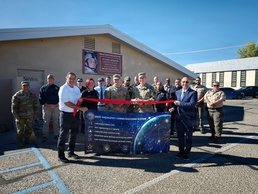
Unified Leadership and Execution To commemorate the system's operational readiness, key installation leaders gathered for a ribbon-cutting ceremony following the acceptance evaluation. The flawless execution of this complex cutover also relied heavily on close, sustained collaboration with Fort Irwin’s Department of Emergency Services.
Through this significant modernization of capabilities, PD BECS continues to pioneer fielding efficiency and technical dominance ensuring the Army is equipped with the first responder tools and speed needed to protect its force.
*This story was authored by Aleyzer Mora Jimenez, Program Analyst for Product Director Base Emergency Communications System.