Natural disasters do not arrive on a schedule, and they rarely unfold according to plan. At Patriot 26, that uncertainty is part of the training.
Approximately 1,000 Airmen and Soldiers from National Guard units across 35 states are participating in Patriot 26 alongside federal, state and local agencies at Volk Field Combat Readiness Training Center and Fort McCoy, Wisconsin, Aug. 24-29, 2026.
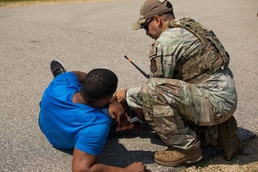
At the Combined Arms Collective Training Facility at Fort McCoy, Tech. Sgt. Joel Ayala, 103rd Security Forces Squadron, Connecticut Air National Guard, served as an acting incident commander Aug. 25 during a scenario involving civil unrest, damaged structures, injuries and communities in need of basic supplies.
For Ayala, who has served for 18 years and previously responded to real-world emergencies including Superstorm Sandy, severe winter weather, and COVID-19 relief operations, the value of Patriot comes from learning how different organizations fit into the larger response.
Ayala said they are not alone, and have many different state partnerships that help them out.
Throughout Patriot 26, role players introduce distractions, competing demands and stressful interactions throughout scenarios, forcing participants to evaluate what is happening around them instead of relying solely on rehearsed responses. Routes may become inaccessible. Casualties may require care. Crowds may become increasingly difficult to manage. Information can change as the scenario develops.
Those complications require service members to pause, assess the situation, and adjust.
Ayala said even reaching the training site required participants to consider how a disaster could affect their movement.
“The direct route is not always going to be the route,” Ayala said. “There’s going to be downed limbs, trees. So, knowing what tools we have available for us, and then having those alternate routes to get out here to help our fellow citizens.”
Patriot 26 also creates opportunities for Airmen with less experience in domestic response operations to learn from those challenges firsthand.
“Seeing those younger Airmen that have never been exposed to this type of exercise or atmosphere, for them to at least retain a bit and put it in the toolbox for future natural disasters that we get activated for,” Ayala said, is an important part of the training.
The learning does not stop when a scenario ends.
Following each exercise event, units conduct an after-action review, or AAR, to identify what worked, what did not and what they need to change before the next iteration.
“We essentially recap the whole day: what went well, what didn’t go well, and what we’re going to implement to improve the next day,” Ayala said.
For Ayala, the process mirrors lessons learned during real-world activations.
“The state partnerships, that’s the biggest part,” Ayala said. “Knowing what we have accessible to us in our toolbox, know that we are not alone.”
Patriot 26 gives Soldiers, Airmen, and civilian partners an opportunity to practice those relationships under pressure before the next disaster is real.
“Natural disasters, there’s not a specific time,” Ayala said. “It just happens, and we have to be readily available to assist.”