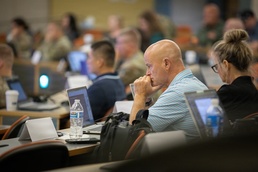
Financial specialists, facility managers and senior leaders from across the country gathered at the Aviation Readiness Center on Joint Base Lewis-McChord for the Construction Facilities Management Office 201 Resource Management Course, an annual National Guard Bureau training event designed to strengthen fiscal execution and resource management across the Army National Guard.
The Washington Army National Guard hosted the three-day course as part of the Army National Guard G9’s national training program. Instruction focused on military construction appropriations, cooperative agreements and budget execution strategies, providing participants with tools to effectively manage funding while remaining compliant with fiscal law.
For Washington, hosting the course provided an opportunity to not only share expertise nationally, but also strengthen the knowledge of its own staff.
“The reason I think it's very important and valuable both to our state and to the staff is, if we're teaching the material, we've got to be the experts on the material,” said Adam Iwaszuk, director of the Construction Facilities Management Office for the Washington Army National Guard. “If we know the funding stream of everything, we can execute funds on time, and we can demonstrate we're not only executing well, but we're teaching it on a national level.”
The course drew in-person and virtual participants from across the country, including resource managers, state CFMO directors and deputy directors, budget analysts and 11 staff members from the National Guard Bureau. Instructors included members of Washington’s CFMO staff, the United States Property and Fiscal Office and internal review auditors, bringing multiple perspectives to the complex process of managing National Guard resources.
CFMO 201 is part of a broader professional development program that includes six 200- level specialty courses hosted by states throughout the year. The courses are designed not only to strengthen expertise within specific career fields, but also to expose personnel to responsibilities outside their normal areas of focus.
“ARNG G9 encourages broadening of CFMO staff and attendance at 200-level courses that are outside of an individual’s area of responsibility,” said Shaun Barclay, Washington CFMO resource manager and primary course proponent. “Understanding the bigger picture and how an individual’s role supports the bigger picture is always valuable.”
That broader understanding is increasingly important as states manage complex funding requirements while maintaining facilities that directly support training, readiness and the quality of life of Soldiers across the Army National Guard.
By standardizing financial practices and keeping leaders current on evolving Department of Defense funding definitions, regulations and requirements, courses like CFMO 201 help states make the most effective use of available resources while planning for future infrastructure needs.
For Iwaszuk, that investment in people ultimately translates into an investment in the Soldiers who rely on those facilities every day.
“Taking time today to invest for the future is what drives us,” Iwaszuk said. “The moment that we're not on the cutting edge of information, regulations or funding, we're not going to be able to deliver the best facilities possible for our Soldiers.”