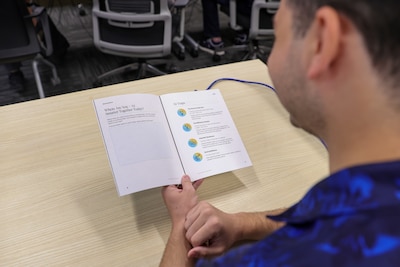
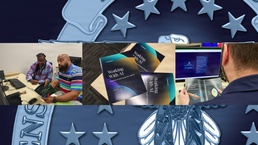
In an increasingly data-driven operating environment, the Defense Logistics Agency Energy Aerospace team hosted an artificial intelligence training session in San Antonio, Texas, establishing a new benchmark for workforce modernization across the agency.
The fully in-person training made Aerospace Energy the first organization within DLA Energy to pilot the coursework, which utilized Franklin Covey instructional material. The primary goal was to equip employees and leaders with "hybrid intelligence"—the ability to confidently combine human insight and judgment with the capabilities of AI.
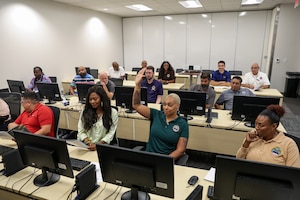
A total of 44 participants engaged in two distinct learning tracks: 35 employees completed*"Working With AI: Essentials for Working Smarter Together,"while nine supervisors participated in"Leading AI Adoption: Accelerate AI Impact Through Empathy and Action."*
"The training supports DLA’s broader effort to build a digital-ready workforce capable of using data, analytics, and AI to improve mission performance," said Ditu Kasuyi, chief of the DLA Energy Acquisition Workforce Development Division.
According to Kasuyi, the training aligns directly with initiatives highlighted by the DLA Chief Information Officer Adarryl Roberts to strengthen supply chain risk management by predicting bottlenecks, forecasting customer demand, and recommending alternative, pre-qualified suppliers during disruptions.
Balancing Technology with Human Judgment
During the classroom sessions, participants engaged in hands-on exercises to explore how human expertise and AI work in tandem. Employees applied practical frameworks like the "Three Golden Questions" to real-world scenarios. Supervisors focused on the human side of technological change, developing strategies to lead teams through transition with empathy, clarity, and action.
Doug Smith, director of Aerospace Energy Supplier Operations emphasized that AI must be viewed as an augmentation tool, not a replacement for human judgment. He explained that while AI can aggregate information and accelerate routine tasks, human subject matter experts remain essential for understanding mission context, evaluating risk, and making final decisions.
"I worked closely with Ditu Kasuyi and Shonda Rizo to bring this training to San Antonio," Smith said. "The DLA director has kept us laser-focused on data acumen and AI, making this course the perfect opportunity to raise the baseline of understanding across our entire staff while equipping our leaders to guide the transition." Smith added that he put his own takeaways from the training into action immediately by fostering a sense of urgency and creating opportunities for staff to share their early AI wins.
"This technology is part of our workflow now, so it is vital we learn to leverage it early," Smith said.
Avoiding Common "AI Traps"
As DLA Energy integrates these tools, officials warned of several common "traps" the workforce must avoid. A primary concern is the creation of "shadow IT" or organizational silos, which duplicate efforts and reduce interoperability.
Kasuyi noted that leaders cautioned against blindly accepting AI-generated information without human review, noting that employees remain fully responsible for the accuracy and quality of their final work. They say that simply granting employees access to AI software does not guarantee successful adoption; structured, practical guidance is required, he said.
When pitfalls are avoided, operational opportunities are enhanced.
"The AI adaptation training has completely changed my workflow," said Keosha Cobbs, a customer account specialist for cryogenics at DLA Energy Aerospace. "Now, instead of being purely reactive, I can be proactive. For instance, when a customer emails us requesting certain processes, I can use the AI tool to gather templates to make the customer response more professional and seamless."
Cobbs noted that the greatest benefit is administrative speed.
"The biggest time saver with AI is having a readily available, high-quality, editable draft in hand for your common daily practices," she said.
Beyond daily office tasks, DLA Energy sees immediate opportunities to use AI, drones, and advanced sensors to support inspections and predictive maintenance at Defense Fuel Support Points, which will allow employees to dedicate more time to critical warfighter logistics.
Shaping the Future of DLA
To sustain this momentum, the training encourages employees to view their daily tasks through an optimization lens. Rather than starting with an AI tool, employees are trained to first ask four critical questions:
"The AI approach that Franklin Covey takes is not a technical approach; it is a human being approach," Kasuyi said. "People were able to connect to that and not get caught up in the tools. It’s really about the principles and concepts that apply to any platform. That type of knowledge and flexibility helped to provide clarity, reduce anxiety, and increase usage."
To share these successes across the broader enterprise, Aerospace Supplier Operations established an internal "AI Tiger Team." The team developed specialized training for local staff, demonstrating specific prompt-engineering techniques and introducing employees toGenAI.mil, the Department of War's centralized AI tool and resource hub.
"This training emphasized that because technology is evolving so rapidly, we have to move out and learn by doing," Smith said. "Our AI Tiger Team initiative was incredibly successful and generated a lot of excitement among our employees. We are currently adapting this training to share with other offices, and depending on their feedback, we may expand it across the rest of DLA Energy."
The Acquisition Workforce Development Division is actively coordinating with other DLA Energy organizations to scale this coursework enterprise-wide.
"Our goal is to move from scattered AI tool usage to a strategic, AI-enabled workforce," Kasuyi said. "When one team finds a responsible way to use AI to improve the work, we have to capture that win, share it, and help the rest of the organization learn from it."