FORT LEAVENWORTH, Kansas — When patients walk into Munson Army Health Center for an appointment, they probably aren’t thinking about whether the lights will come on, the water will flow or the temperature in the laboratory is within the required range.
That’s a good thing.
Behind the scenes, Munson’s facilities team works to make sure the building and the systems inside it are ready to support the healthcare mission every day.
“We’re responsible for the environment of care for every medical and dental space on this installation,” said Joe McGovern, Munson Army Health Center chief of facilities.
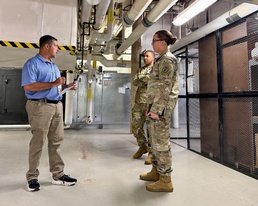
McGovern recently took the health center’s new director, Col. Tiffany Bilderback, and new senior enlisted advisor, Sgt. Maj. Devon Woodard, into some of those less-visible areas, from mechanical spaces to the roof, for a closer look at the infrastructure supporting patient care.
“As the director, it’s important for me to understand what it takes to keep this facility operating, in addition to what happens in our clinical spaces,” Bilderback said. “Seeing these systems firsthand and hearing from the people who maintain them gives me a better understanding of what they need to support our healthcare mission every day,” Bilderback said.
That responsibility covers a lot of ground. The team helps ensure reliable power, heating and cooling, water, fire protection and other building systems while meeting healthcare-specific safety and accreditation requirements.
Some of those responsibilities have a direct connection to patient care. Laboratory testing and temperature-sensitive medications and supplies, for example, depend on properly maintained environmental conditions.
Emergency power helps ensure critical systems are supported when normal power is interrupted.
Maintaining that infrastructure can be particularly challenging in a building that has served the Fort Leavenworth community for more than six decades.
The current facility, Fort Leavenworth’s fifth hospital, was completed in January 1961. It underwent a major modernization in 1985 and was redesignated Munson Army Health Center in 1997 as its mission transitioned from inpatient hospital operations.
McGovern has seen some of that evolution firsthand, including changes in clinical services that required corresponding changes to the building and its systems.
Other members of the facilities team bring experience maintaining both healthcare and non-medical facilities. Manny Sims, who previously worked with military medical facilities in the San Diego area, said the team occasionally responds after hours when an alarm or facility problem requires attention.
“We usually get everything done and everything seems to work out,” he said.
That’s largely the point.
Patients and most staff will never visit Munson’s mechanical spaces or central utility plant. They may never meet the people maintaining its electrical, plumbing, heating, cooling and safety systems.
But every appointment, prescription, laboratory test and healthcare service provided inside the building depends in some way on a facility that is safe, functional and ready.
“There is a remarkable history of caring for Soldiers and families here at Fort Leavenworth that stretches back nearly 200 years,” said Bilderback. “Every generation has had people behind the scenes making that care possible. Today, our facilities team is part of continuing that legacy and making sure we are ready to care for the community that depends on us.”