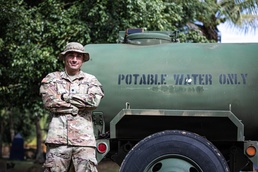
Story by Staff Sgt. Agustín Montañez, Puerto Rico Army National Guard
CANÓVANAS, Puerto Rico — At Spc. Jesús D. Ramos Jiménez's house in Barrio Carraízo, in the hills of Trujillo Alto, the family leaves one faucet slightly open.
No schedule reliably tells them when water service will return, Ramos said. Sometimes a neighbor calls out that the water is back. Sometimes they hear the faucet sputter to life. Then his wife and two daughters fill buckets and other storage containers, because no one knows how long the supply will last.
“At my house, the outages have been constant,” Ramos said. “We've had more days without water than with it. I can count the days we've had water on one hand, and I would still have fingers left.”
About an hour's drive from his home, on the banks of the Río Grande de Loíza in Canóvanas, Spc. Ramos, 32, spends his days managing a different flow. He is a water treatment specialist assigned to the 105th Quartermaster Company, 191st Regional Support Group, Puerto Rico Army National Guard. Since Aug. 10, he and 14 other Soldiers have treated water from the Río Grande de Loíza — one of Puerto Rico's major rivers by watershed area and discharge — to produce potable water for municipalities affected by water-service disruptions.
The same drought has put Ramos on both sides of the emergency — a Soldier producing water for affected communities, and a resident whose wife and two daughters are rationing it at home.
Puerto Rico is living through its most serious water crisis since the 2015 drought. San Juan recorded its driest July in more than 120 years of record-keeping, according to the National Weather Service, and as of Aug. 20, extreme drought covered one-third of the island — nearly double the area of the week before — with more than 60% under at least severe drought, according to the U.S. Drought Monitor.
On July 31, Gov. Jenniffer González Colón signed two executive orders declaring a state of emergency over water use and activating the National Guard to assist with hauling, distributing and purifying water. A rationing plan now cycles roughly 183,000 utility customers — more than half a million people across San Juan, Trujillo Alto, Carolina, Canóvanas, Loíza, Gurabo and Juncos — through alternating 48-hour periods without service. Canóvanas itself, along with Río Grande, had already been under scheduled interruptions since early July because of reduced flows to the filtration plant serving those municipalities. Forecasters, citing a strengthening El Niño, put the odds of below-normal rainfall through October above 70%.
The Guard's water effort, Mission Clear Source, began June 7 with potable-water distribution and expanded after the July 31 orders to include purification, with Soldiers operating mobile reverse osmosis systems at sites including Canóvanas and San Juan.
The Canóvanas site sits on the grounds of a recreational fishing association whose members share their riverside facilities with the troops. Operations at the site began on Aug. 10. In the first days, the crew worked roughly 18-hour shifts before the schedule settled closer to 12-hour shifts.
By Aug. 24, the site had purified 134,180 gallons of water, according to production logs kept at the site — including 58,785 gallons over a single four-day stretch in mid-August, tallied by Spc. Erika Vega, a water treatment specialist, also with the 105th Quartermaster Company, who tracks every gallon produced, transferred and dispatched. Daily output depends in part on how much water municipal crews can distribute, the site's leadership said.
Staff Sgt. Alexis Ramos runs the site as its noncommissioned officer in charge. A water treatment specialist with 16 years of service who works as a police lieutenant in his civilian life, he lives in Canóvanas, one of the first municipalities to lose regular service.
He is quick to correct the most common misconception about his job.
“People think we arrive with a machine, put a hose in the water and it comes out ready to drink,” he said. “They don't understand the complexity of the process required for that water to come out within the parameters for them to consume it.”
The process starts at the river's edge, where a raw water pump pulls water through a strainer that keeps out large debris. From there it passes through a sand-based media filter, then through a bank of ten cartridge filters, before a high-pressure pump forces it through reverse osmosis elements — the heart of the system, a Reverse Osmosis Water Purification Unit, or ROWPU. This system is capable of producing 3,000 gallons of drinking water per hour.
Even then, the water is not finished.
“The difference between purified water and potable water is chlorine,” the staff sergeant said. “Once you inject chlorine into the water, it becomes potable.”
He called it both physical and mental work — moving heavy hoses under the sun, stopping every hour to test the water and troubleshooting equipment where guesswork is not an option.
Soldiers test the water every hour — chlorine, pH, turbidity — at the machine's outlet, in each of the site's four 3,000-gallon storage tanks, in two 6,000-gallon municipal tanks and in the tanker trucks, which typically leave with about 2,000 gallons per load.
The river itself is tested every morning, because it changes — rain upstream can push new sediment into the intake, forcing the crew to recalibrate the equipment before production can safely continue.
The Army has its own field-water standards under Technical Bulletin MED 577, but because this water is destined for civilians, the site defers to the Puerto Rico Department of Health's requirements, with the Puerto Rico Aqueduct and Sewer Authority certifying each dispatch. Before a new site can release water at all, samples must be sent to a laboratory on the U.S. mainland — a turnaround the NCOIC estimates at 48 to 72 hours in an emergency.
If a sample falls outside the parameters, the water does not move.
“We cannot dispatch water that isn't within the parameters,” Spc. Ramos said. It is the part of the job that weighs on him most — “A wrong number in the chemicals can affect a lot of people.”
That sentence could describe his civilian career, too. Jesús Ramos works for the Puerto Rico Department of Health's lead poisoning prevention program, sampling water at schools and childcare centers to check for lead in the pipes — a job he says he landed because of the training the Army National Guard gave him. When a Health Department official arrived to certify the Canóvanas site, Ramos recognized him. They had worked together before.
He was sitting in his Health Department office when the call came, two or three days before mobilization. His supervisor, Wilmarie Muñiz, sent him off with blessings, he said. His wife, Darelis Sánchez — who had pushed him toward the water treatment specialty in the first place — did the same.
At home, the drought has rearranged everything. Ramos normally drops his daughters — Azeneth, 10, and Eliette, 2 — at school and childcare. Now his wife juggles that alone around her own job as a caregiver. With the household's water heating unavailable, the girls have been bathing in cold stored water. Before each stretch at the site, Ramos stages enough water at the house to last about a week; when the level drops, he goes back up to refill what he can.
“It weighs on me, knowing I'm here working and they're over there with the same need we're addressing,” he said. “But I feel very grateful for the opportunity to be working here — not just for the experience I'm gaining, but knowing the water is getting to different places in need of it. That gives me satisfaction.”
His NCOIC sees it from the outside.
“I admire him a lot,” Staff Sgt. Ramos said. “He has his family, they're going through the water shortage, and even so he's committed to the people — even though his family is also part of the people. Another person would think, ‘I'd rather be home with my family.’ But he's here with us, serving his community.”
Not everyone on the team is living the drought the same way. Spc. Ángel Álvarez, a petroleum supply specialist with 15 years in the Guard who keeps the site's generators, pumps and vehicles fueled, lives in Juana Díaz, where the rationing has not reached. Nevertheless, for him, the crisis has a face.
“The need has not reached my home, but I've been able to somewhat experience it by seeing the situation through Ramos' eyes,” Álvarez said. For him, the mission illustrates a less visible part of National Guard service — it does not always take soldiers far from home; sometimes it brings the work directly into their own communities.
On the afternoon of Aug. 19, distant thunder rolled as gray clouds gathered above the river. Across the water, green vegetation was broken by patches of drought-yellowed growth. Ramos had to raise his voice over a generator, purification equipment, trucks and a nearby lawn mower. Even while answering questions, he repeatedly glanced toward the machinery and his fellow Soldiers operating it.
At about 5:40 the next morning, a sandy-colored dog the Soldiers called “Chiqui” wagged and whined at the team through a padlocked gate while they waited for a key. Before 6 a.m., a heat advisory was already in effect. The temperature stood at 78 degrees, with relative humidity at 87%, and several Soldiers had removed their uniform blouses and were working in tan T-shirts and boonie hats. They began with source-water samples and maintenance checks, comparing the river's readings with those from the day before.
The 15 Soldiers at the site — most from the 105th, plus two medics from the 1065th Medical Company, and a tactical power generation specialist from the 783rd Support Maintenance Company — spent their first week sleeping on cots at the work site, packing up each morning so the fishing association's members could use their own grounds. The municipality then arranged lodging in the locker room of the Carlos Miguel Mangual Coliseum, about ten minutes away.
Even there, the drought sets the schedule. Water at the coliseum runs only during a daily service window, so the crew races to close out operations — final chemical readings, production reports, policing the site — in time for everyone to shower before the taps go dry. Miss the window, and it's bucket baths. The Soldiers producing drinking water for the public plan their own evenings around an outage.
The night of Aug. 19, Ramos left the site around 6:30 p.m. to handle a family matter. He got home around 7:30 p.m., went to bed around 11 p.m., and woke when his alarm sounded at 4 a.m. His wife woke with him; his daughters slept as he dressed, said goodbye, and started down out of the hills. He began the drive with quiet instrumental music, later switched to salsa, thinking, he admitted with a laugh, mostly about that first coffee the team brews at the site every morning. By 5 a.m. he was back at the coliseum.
He said he manages the two responsibilities by giving each his attention in its place. “When I am here, I try to focus on what I am doing here,” Ramos said. “When I am home, I focus on my family and what is happening there.”
Ramos enlisted in the Puerto Rico Army National Guard in 2023, and this is his first operational water purification mission. Training had taught him the sequence — pumps, filters, chemicals, tests. Seeing it all deployed against a real emergency changed the scale of that knowledge.
“That first image of everything set up, not just for practice but for a real situation, is something I think will stay with me,” he said.
His NCOIC wants the public to understand what the mission costs to the people running it.
“Not everyone has it in them, when there's an emergency, to leave their home, leave their comforts, to come work under the sun, sleep somewhere that isn't your house, isn't your bed,” Staff Sgt. Ramos said. “You change your whole way of life to serve. I at least live close to here, but the rest of the team's sacrifice is greater — they stop seeing their kids, their parents, their spouses, to be here serving others.”
Spc. Ramos does not know whether any of the water leaving the Canóvanas site reaches his own neighborhood. He believes a separate purification site in San Juan may be the one serving parts of Trujillo Alto, but delivery routes are set by civilian authorities.
“I'm confident the water we're producing is reaching the families who truly need it,” he said. “Everyone here is doing their part. We come from different towns, different ages and different walks of life, but we put our civilian routines aside for early mornings and late nights so other families can get at least a little relief.”
At the river, Ramos listens for a change in the pumps and watches the numbers that decide whether the water can move. In the hills of Trujillo Alto, his family listens for the first sputter from a half-open faucet.
In both places, the next sound means someone is waiting on water.